


TL;DR
- Most enterprise information is trapped in unstructured documents, and intelligent document processing use cases exist to free it and feed it into your core systems.
- The highest-value use cases cluster in finance, logistics, insurance, HR, and legal, wherever document volume and stakes are both high.
- Modern IDP runs a six-step pipeline: ingest, pre-process, classify, extract, validate, and integrate, all without per-vendor templates.
- Typical results include 60% to 80% lower processing costs and 99%+ field accuracy with human-in-the-loop review.
Most of what a company knows is unreadable to its own systems. Industry estimates from IDC and Gartner put unstructured data at roughly 80% of all enterprise information, locked inside unsearchable PDFs, email bodies, handwritten notes, and image attachments.
Gartner named this the “dark data” problem more than a decade ago, and it remains a critical operational bottleneck: the data sits there, paid for and stored, returning almost nothing because no system can read it at scale.
The most valuable intelligent document processing use cases all solve the same thing: they act as a data translator that connects chaotic front-end document inflows with structured back-end corporate systems. Instead of a person retyping a vendor’s invoice into an ERP, the document flows in, gets read, validated, and posted automatically.
This guide covers the top IDP use cases for 2026 across finance, logistics, insurance, HR, and legal, explains how the technology works under the hood, and shows the benefits that follow.
What Is Intelligent Document Processing (IDP)?
Intelligent document processing is an AI-powered technology that captures, classifies, extracts, and validates data from documents of any layout, using OCR, machine learning, and natural language processing to turn unstructured files into structured, system-ready data without templates. It is the bridge between a scanned page and a clean database record.
Shifting from Simple Text Ingestion to Contextual Comprehension
The leap from older tools to modern IDP is the leap from transcribing to understanding. Traditional, rule-bound software depends on fixed templates and breaks the moment a layout shifts, which means every new vendor or form variant becomes a maintenance ticket.
Next-generation intelligent document processing uses machine learning models and large language models to read a document contextually, the way a human operator would, which makes it resilient against variable layouts.
Instead of failing on a new vendor’s invoice, it recognizes the supplier, line items, and totals by meaning and keeps working. That resilience is what turns a narrow automation script into a platform that can handle the full, messy variety of real document traffic.
Top Intelligent Document Processing (IDP) Use Cases Across Modern Enterprises
The strongest IDP use cases appear in document-heavy functions where manual handling is slow, costly, and error-prone.
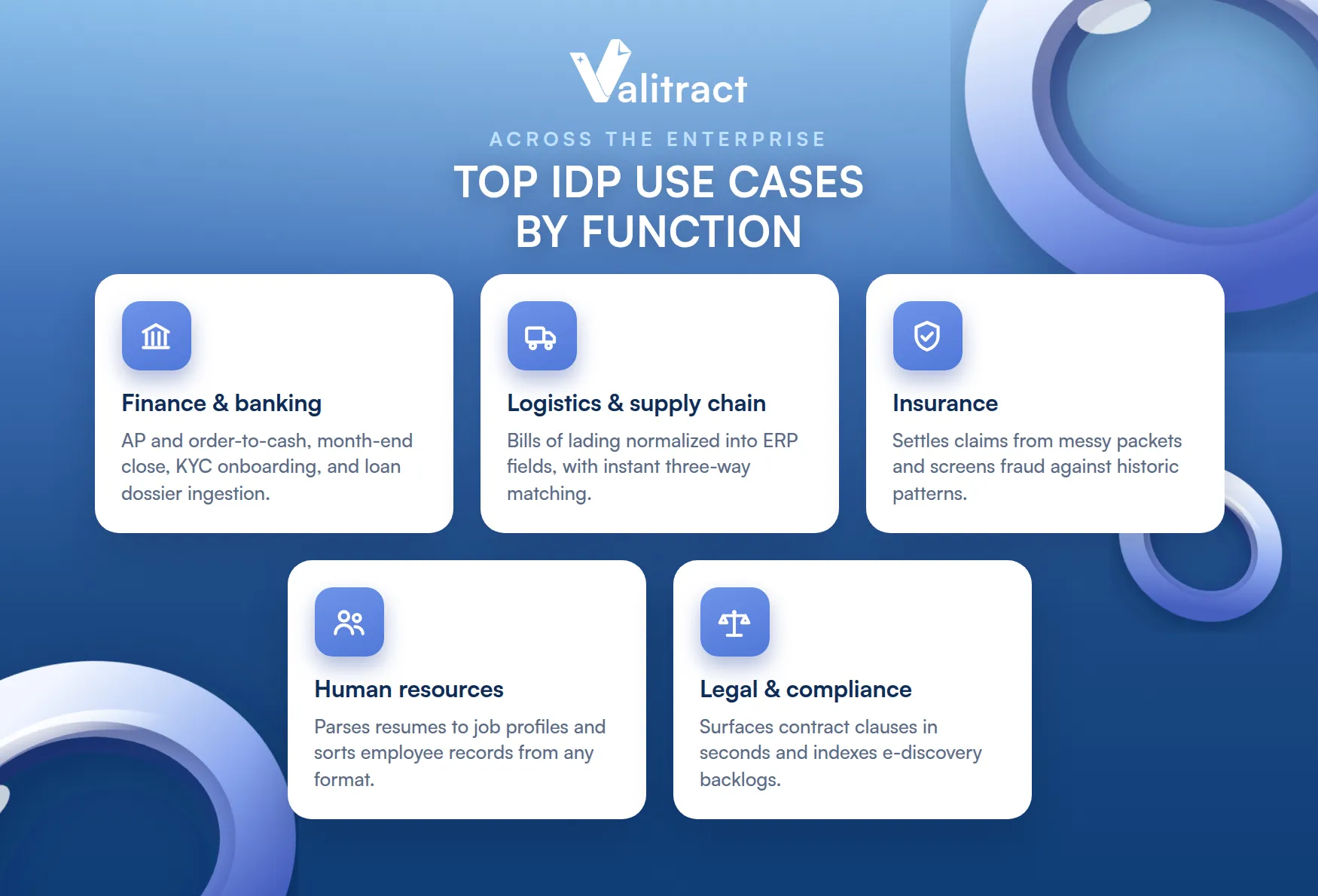
The five verticals below show the pattern, along with the specific operational pain points and document friction each one removes.
Finance and Banking
Finance is the densest cluster of IDP use cases, because nearly every process starts with a document and ends in a ledger entry. The friction is constant: every supplier formats invoices differently, every bank statement spans multiple pages, and every onboarding packet mixes document types. Four use cases stand out.
- Accounts payable and order-to-cash: the pain is that supplier invoices and purchase orders arrive in endless layouts, and a clerk has to find the total, tax, and line items on each one by hand. IDP automates that ingestion, handling unpredictable billing layouts natively and extracting multi-row item tables, tax classifications, and shipping costs. This is the backbone of modern accounts payable invoice processing, where touchless flow depends on reading any vendor format on the first pass.
- Record-to-report: the month-end close is a high-pressure scramble to reconcile data scattered across statements and sub-ledgers. IDP extracts and balances ledger data directly from complex multi-page bank statements, sub-ledger records, and corporate expense files, which compresses a close that once took days.
- Customer and vendor onboarding (KYC): the friction is manual review of identity files that delays activation and invites compliance risk. IDP scans identity documents, passports, corporate charters, and utility bills to confirm legitimacy without keying delays, so a new account or vendor is verified in minutes rather than days, and the verification leaves a clean record for later audit.
- Mortgage and loan ingestion: a single application dossier can run dozens of pages across many document types. IDP processes tax returns, employment records, credit papers, and valuation certificates together, isolating the fields underwriters need and cutting approval times.
Transportation, Logistics, and Supply Chain
Logistics teams drown in variable, multi-language paperwork from carriers worldwide, and a single missed field can stall a shipment. The friction is that no two carriers format a document the same way, yet the data has to land in the same ERP fields. Two use cases dominate.
- Freight logistics ingestion: the pain is reading dense, variable, multi-language profiles such as bills of lading, commercial customs declarations, and shipping manifests, each with its own structure. IDP normalizes those formats natively, pulling container IDs, gross weights, ports of loading, and SKU line items into a consistent schema regardless of the source layout. A new carrier no longer means a new template or a new backlog at the terminal.
- Inventory reconciliation: receiving teams on a warehouse floor cannot wait for a back-office clerk to key a packing slip. IDP captures receiving slips and packing rosters on the spot, triggering instant three-way matching against the original purchase orders and flagging shortages before goods are shelved, which keeps inventory counts accurate from the moment a truck is unloaded.
Insurance Operations
Insurance runs on documents that are urgent, unstructured, and fraud-prone, so the cost of slow or sloppy handling is high. Claims arrive as a messy bundle of forms, photos, and reports, and every hour of manual routing delays a settlement or lets a fraudulent claim through. Two use cases lead.
- Hands-free claims adjusting: the friction is that a claim packet mixes incident sheets, police files, vehicle damage photos, and medical billings in no fixed order. IDP processes that unstructured bundle, extracts the relevant fields, and settles minor claims instantly without manual routing, reserving human adjusters for complex cases.
- Data-driven fraud screening: the pain is that fraud hides in patterns a tired reviewer cannot spot under deadline pressure. IDP checks extracted claim data against historic patterns in real time, flagging duplicate submissions, modified dates, and unverified provider profiles before a payout clears.
Human Resources
HR teams handle a constant stream of unstructured candidate and employee documents, and the volume spikes with every hiring push. The friction is that resumes, certifications, and forms all arrive in personal, inconsistent formats that resist any template. Two use cases recur.
- Resume profiling and matching: recruiters cannot read thousands of resumes by hand for every opening. IDP parses unstructured resumes and cover letters, mapping each candidate’s skills and history against internal open job profiles so shortlists build themselves.
- Employee lifecycle management: onboarding and ongoing records bury HR in tax configurations, health certifications, and performance reviews. IDP ingests and sorts these into the right employee profiles securely, keeping central records current without manual filing.
Legal and Corporate Compliance
Legal work is reading at scale, and reading is exactly the bottleneck IDP removes. The friction is that critical terms hide inside hundred-page documents, and a missed clause can carry real liability. Two use cases stand out.
- Contract review automation: the pain is hours spent combing 100-page lease contracts and master service agreements for specific terms. IDP locates liability clauses, indemnification thresholds, and upcoming termination timelines in seconds, then surfaces them for a lawyer to confirm rather than hunt for.
- Litigation e-discovery: discovery phases bury teams under immense backlogs of historic emails, briefs, and internal files. IDP reviews and categorizes that unstructured archive, turning weeks of manual review into a searchable, structured index that legal teams can query.
Across all five verticals the pattern is identical. The documents are variable, the volume is high, and the cost of a manual mistake is real, whether that mistake is a misposted invoice, a misrouted claim, or a missed contract clause. IDP fits wherever those three conditions overlap, which is why a single platform can serve finance, logistics, insurance, HR, and legal teams from the same underlying engine.
The Technical Processing Pipeline: How IDP Platforms Work
Under the hood, modern intelligent document processing software runs a clear, chronological pipeline.
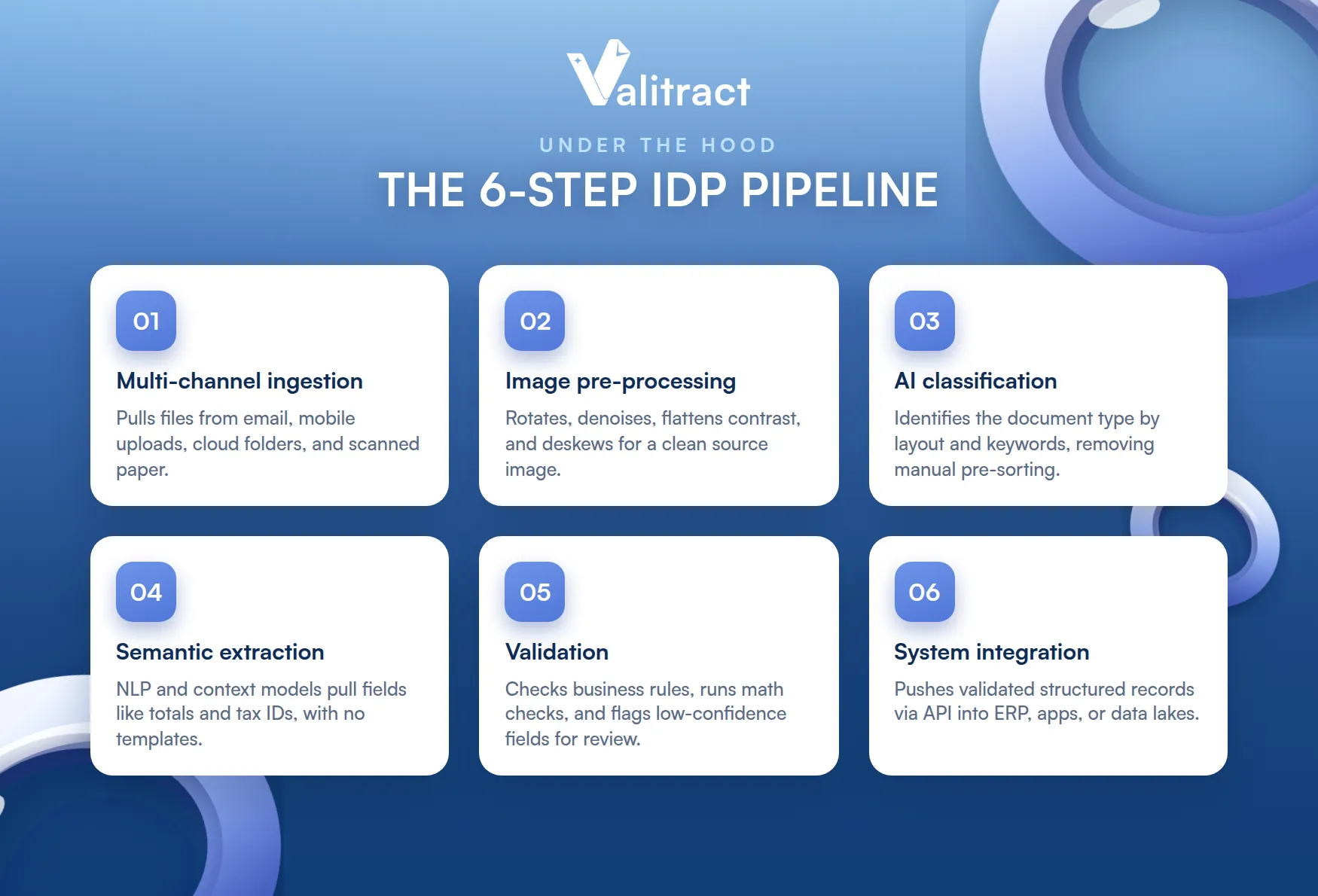
Each step prepares the data for the next, and knowing the sequence helps you judge where a platform is strong.
- Multi-channel document ingestion: the platform automatically pulls files from shared corporate emails, mobile image uploads, cloud folders, and scanned paper streams, so documents enter the pipeline no matter how they arrive.
- Image pre-processing and optimization: computer vision rotates pages, removes background noise, flattens contrast, and deskews text lines, because a clean source image sets the ceiling for everything that follows.
- AI document classification: it identifies the document type, distinguishing an invoice from an HR file or a contract by layout and keywords, which eliminates the manual pre-sorting step that used to gate every downstream process.
- Semantic data extraction: natural language processing and context-aware models extract targeted fields such as item rows, tax IDs, and totals without template constraints. This is the role of a capable AI data extraction tool.
- Trust rules and business logic validation: the software checks extracted data against business rules, runs automatic math checks, and flags low-confidence fields for human-in-the-loop review.
- Target system integration: validated, structured records are pushed through cloud APIs into ERP tools, corporate applications, or data lakes.
The difference between a good platform and a fragile one shows up at steps three through five. Weak tools misclassify documents, lean on rigid templates for extraction, or skip validation and let bad data through. Strong tools classify reliably, extract by meaning without templates, and route every low-confidence value to a reviewer, so the data that reaches step six can be trusted.
Core Benefits of Implementing Intelligent Document Processing (IDP)
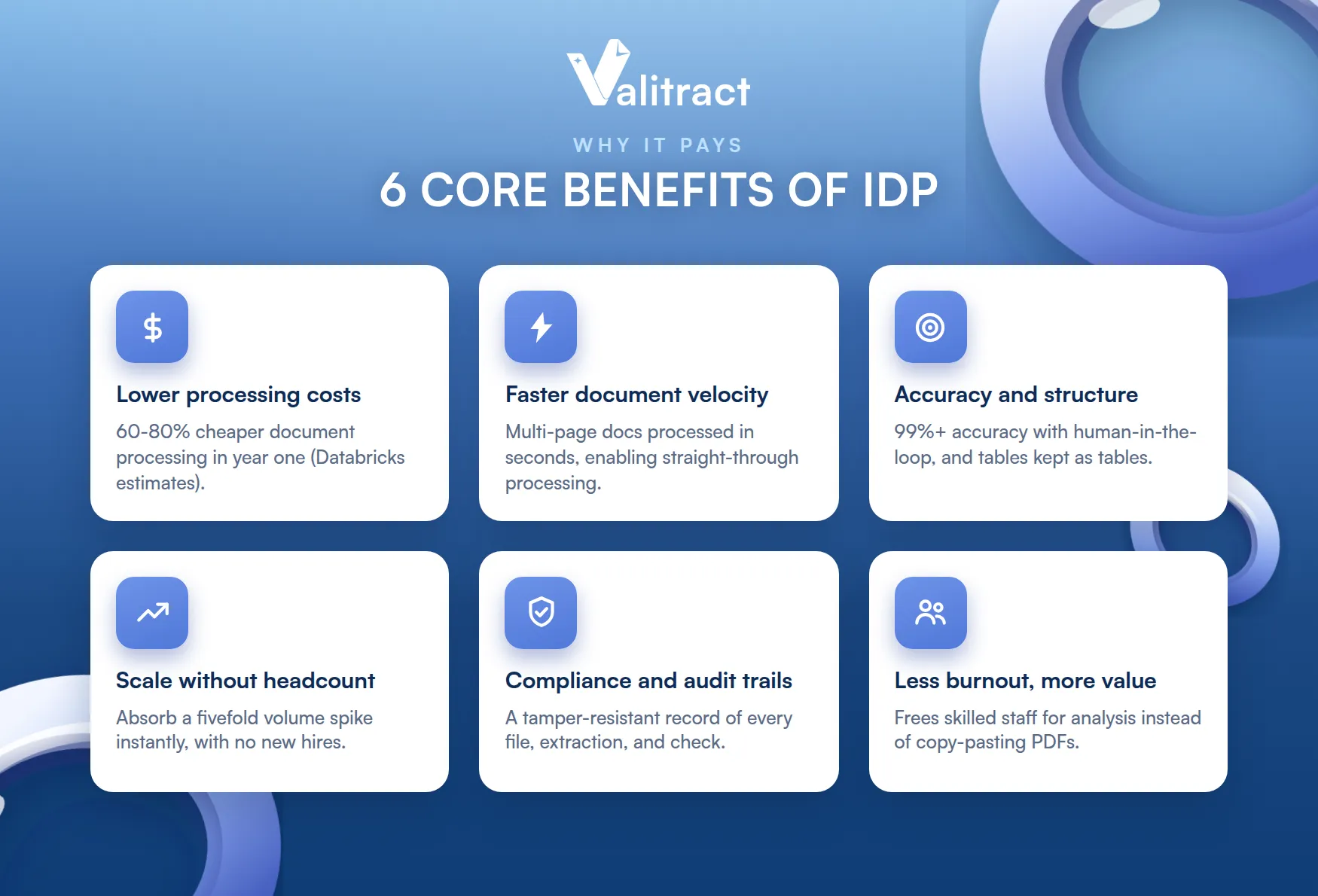
The return on an AI-native IDP platform goes well beyond a vague productivity bump. It reshapes cash velocity, risk, and operational scale, and the gains reinforce one another: faster processing lowers cost, cleaner data lowers risk, and lower risk frees the team to scale. Six benefits stand out.
1. Drastic Reduction in Transactional Processing Costs
Manual data keying is an expensive, hidden drain on capital. Shifting from manual entry to automated AI extraction typically cuts document processing costs by 60% to 80% within the first year, according to industry estimates cited by Databricks, with some organizations saving millions annually.
Labor spend drops as teams move from typing data to validating exceptions, and the saving compounds because the same staff can handle far higher volume. The cost that disappears is not only wages; it is the rework, the late-payment penalties, and the error correction that manual entry quietly generates every month.
2. Exponential Acceleration in Document Lifecycle Velocity
Traditional data entry stretches cycles to days or weeks. An advanced IDP system ingests, classifies, parses, and logs multi-page documents in seconds. That speed enables high straight-through processing rates, where clean documents flow end to end with no human touch and only exceptions stop for review.
For finance teams, the velocity translates directly into money: invoices clear in time to capture early-payment discounts, and contracts move without the delays that used to stack up in an approval queue.
3. Superior Data Accuracy and Structural Integrity
Human fatigue produces transposed numbers and missed rows in dense tables, and a single wrong digit in a total can corrupt a downstream report. Context-aware natural language processing isolates line items with far greater precision, and combined with human-in-the-loop review screens, it delivers data to downstream databases with 99%+ accuracy.
The structural integrity matters as much as the character accuracy: IDP preserves the parent-child relationships between a header and its line items, so a table arrives as a table rather than a flattened block. Pairing extraction with dedicated invoice validation software adds a second layer of checks on financial documents.
4. Frictionless Operational Scalability Without Headcount Growth
Seasonal spikes and rapid expansion normally force companies to hire temporary staff, train them, and absorb the error rate that comes with rushed onboarding. An AI-driven IDP system can absorb a fivefold jump in document volume instantly, with no additional headcount, which gives operations real elasticity.
Capacity becomes a configuration setting rather than a hiring plan, so a quarter-end surge or a new market launch no longer means a scramble for temporary workers who leave once the peak passes.
5. Strengthened Compliance, Risk Mitigation, and Audit Trails
Ad-hoc document handling exposes companies to compliance and fraud risk, because no one can prove what happened to a file that passed through a dozen inboxes. IDP platforms build an automated, tamper-resistant digital audit trail for every file, logging who reviewed a document, which data points were extracted, and which checks passed.
That record catches anomalies like duplicate billings or modified bank details, and it makes regulatory reporting far less painful, since the evidence an auditor asks for is already captured rather than reconstructed after the fact.
6. Elimination of Workforce Burnout and Higher Employee Value
Forcing skilled finance, legal, and HR staff to copy-paste from PDFs into ERP software drives disengagement and turnover, and it wastes the expertise those people were hired for.
Automating ingestion frees those teams for high-impact work such as supplier contract negotiation, data analysis, and cash-flow optimization.
The people you hired for judgment get to use it, which improves both retention and the quality of the decisions the team makes. Over time, that shift from clerical work to analysis is often the benefit leaders value most, even though it is the hardest to put on a spreadsheet.
How Valitract Integrates IDP into Business Workflows
Valitract applies these IDP principles as a template-free platform that turns documents into validated, structured data and pushes it into the systems your team already runs.
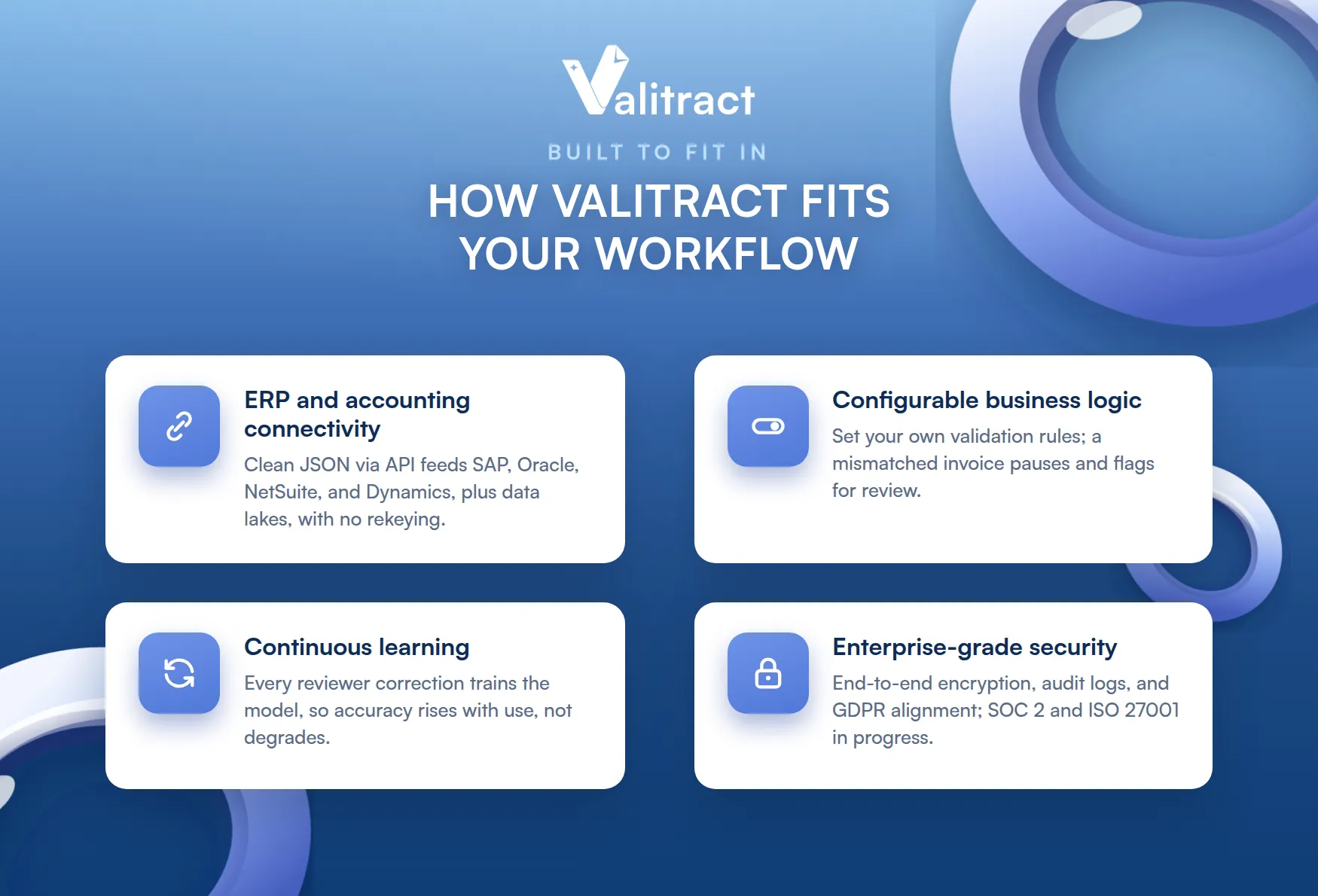
The aim is to slot into an existing workflow rather than replace it, so the data lands where people already work. Four capabilities define how it fits.
- ERP and accounting connectivity: Valitract returns clean, structured data through its API so it can feed downstream systems such as SAP, Oracle, NetSuite, and Microsoft Dynamics, placing extracted values into the right fields without manual rekeying. Because the output is standardized JSON, the same extraction can feed an ERP, a data lake, and an analytics layer at once.
- Configurable business logic: teams set their own validation rules instead of accepting a fixed set. If an invoice total does not match the purchase order, Valitract pauses the workflow and flags the document for review in a clean, intuitive interface, so a discrepancy is caught before it becomes a payment error rather than after.
- Continuous learning: the platform uses a feedback loop, so every time a reviewer corrects a low-confidence field, the underlying model learns from that input and future processing gets more accurate. Accuracy rises with use rather than degrading as new document formats arrive, which is the opposite of how template-bound tools age.
- Enterprise-grade security: Valitract protects data with end-to-end encryption and comprehensive audit logs, and it is GDPR-aligned, with SOC 2 Type II and ISO 27001 certification in progress. Every processed file leaves a record of what was extracted and who reviewed it, which supports the audit trail regulated industries require.
Concluding Thought
The common thread across every intelligent document processing use case is the same: documents are where work begins and where it stalls, and IDP removes the stall. Whether the bottleneck is a finance team rekeying invoices, an insurer routing claims by hand, or a legal team reading contracts line by line, the payoff comes from turning unstructured inflows into structured, validated data your systems can act on.
The teams that win in 2026 will treat document processing as automated infrastructure, not manual labor, and they will start with one high-volume process rather than trying to automate everything at once. Pick the workflow that hurts most, measure the before and after, and expand from there.
To see template-free IDP on your own documents, explore Valitract’s AI-powered data extraction.
Frequently Asked Questions About Intelligent Document Processing Use Cases
What is intelligent document processing (IDP)?
Intelligent document processing is an AI-powered technology that captures, classifies, extracts, and validates data from documents of any layout. It combines OCR, machine learning, and natural language processing to convert unstructured files such as invoices, contracts, and forms into structured, system-ready data, usually without per-document templates and with human-in-the-loop review for low-confidence fields.
How does intelligent document processing software differ from automated document processing?
Automated document processing relies on rules, templates, or scripts and works best on structured, predictable documents, handling tasks like scanning, indexing, and storing. IDP goes further by understanding content contextually with machine learning and language models, so it reads variable and unstructured documents, extracts meaning, validates the result, and integrates it into business systems. In short, automated document processing digitizes, while IDP comprehends.
What are the most common intelligent document processing use cases in finance?
The most common finance use cases are accounts payable and order-to-cash automation, the record-to-report month-end close, customer and vendor onboarding through KYC document checks, and mortgage or loan application ingestion. Each one replaces manual keying of variable documents with automated extraction and validation, which lowers cost, speeds cycles, and reduces errors.
Valitract – Next-gen AI-Powered Data Extraction Platform
- Email: contact@valitract.com
- LinkedIn: https://www.linkedin.com/company/valitract-api-platform
- X: https://x.com/valitract