


TL;DR
- Identity verification automation uses AI to confirm who a person is from their documents and biometrics, replacing slow manual review.
- A typical flow captures the document, extracts the data, authenticates it, matches the person to it, and routes a decision.
- Automation cuts verification from days to under a minute and lowers cost per check by up to 70% (Tecalis).
- The document capture and data extraction layer, is the foundation the rest of the stack depends on.
Identity verification automation is the use of AI to confirm a person’s identity from their documents and, where needed, their biometrics, without manual review of every case. It has moved from a convenience to a requirement.
Onboarding volumes have outgrown what human reviewers can handle, regulators demand clean KYC and AML audit trails, and fraud now includes deepfake and tampered IDs that people miss. At the same time, digital-native customers expect to be verified in under a minute.
This guide explains what identity verification automation is, how it works step by step, the technology behind it, where it adds the most value, and how to choose the right level of automation for your business.
What Is Identity Verification Automation?
Identity verification automation confirms a user’s identity using AI and machine learning instead of manual checks. It reads identity documents and biometric data, validates them, and returns a decision in seconds rather than hours.
The Core Definition
Automated identity verification is the process of verifying a person through their documents, such as an ID card, passport, or driver’s license, and biometric data, using AI and machine learning in place of manual review.
Every system rests on three core stages:
- Document capture: the user submits an ID image by camera, upload, or API.
- Data extraction: AI reads the fields from the document and structures them.
- Validation and decision: the system checks the data, matches the person, and approves, rejects, or escalates.
Manual Verification vs. Automated Identity Verification: What Is the Difference?
Manual review depends on people reading documents one by one, which is slow and inconsistent at volume. Automation does the same checks in seconds and records every step. The table shows the difference across the measures that matter.
Table 1. Manual vs automated identity verification
| Dimension | Manual verification | Automated verification |
| Processing time | Minutes to hours, often days for full KYC | Seconds, under a minute end to end |
| Error rate | Higher and inconsistent under volume | Lower and consistent |
| Scalability | Limited by headcount | Scales on demand |
| 24/7 availability | No, business hours only | Yes, always on |
| Compliance audit trail | Manual, with gaps | Automatic and complete |
| Cost per verification | About €30 to €150, far more for enhanced reviews | Up to 70% lower |
Sources: Tecalis (cost range and up to 70% reduction), Deloitte 2025 Digital Identity Report (45 to 60% faster onboarding for individuals).
Why Businesses Are Automating Identity Verification Now
Businesses are automating identity verification to tackle exploding onboarding volumes, stringent compliance mandates, sophisticated deepfake fraud, and modern customer expectations for sub-one-minute processing.
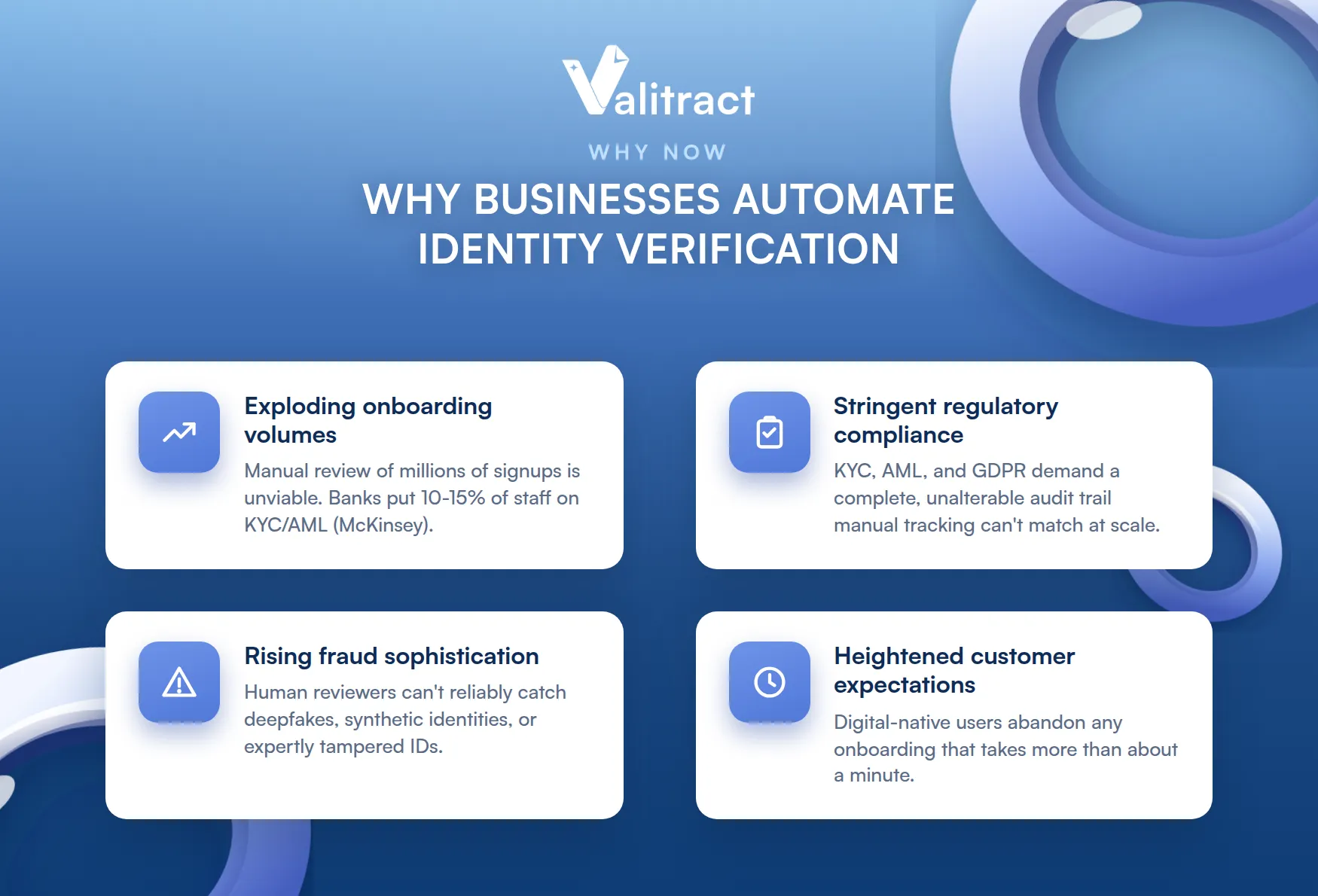
Four critical market pressures have converged, making automated KYC onboarding an operational baseline rather than an optional upgrade:
- Exploding onboarding volumes: Reviewing millions of registration requests by hand is no longer operationally viable. A McKinsey benchmark found that many financial institutions are forced to dedicate 10% to 15% of their entire workforce strictly to manual KYC and AML tasks.
- Stringent regulatory compliance: Evolving KYC, AML, and GDPR frameworks require an accurate, complete, and unalterable digital audit trail that manual document tracking cannot reliably produce at scale.
- Rising fraud sophistication: Traditional human reviewers can no longer reliably spot hyper-realistic, AI-generated deepfakes, synthetic identities, or expertly tampered IDs under rapid turnaround pressures.
- Heightened customer expectations: Today’s digital-native users demand frictionless transactions and will quickly abandon any onboarding or account creation process that takes more than about a minute to complete.
How Identity Verification Automation Works Step by Step
Automated verification runs in five stages, from capturing the document to routing a decision.
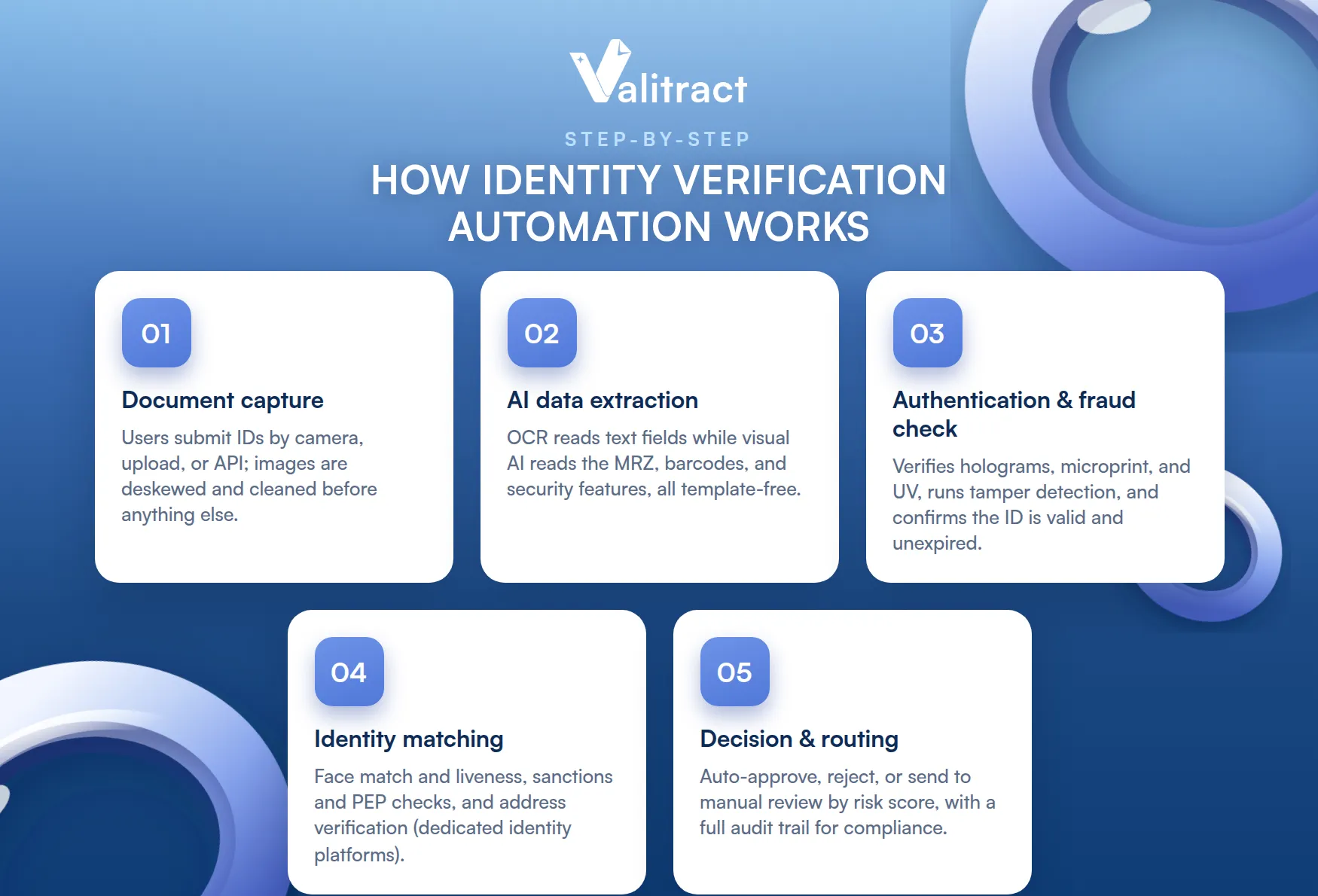
Modern platforms run the routine cases end-to-end and send only edge cases to a person.
Step 1: Document Capture
Capture is the entry point, and its quality sets the ceiling for everything after it. Users submit documents by mobile camera, web upload, or API.
Supported documents typically include passports, national IDs, driver’s licenses, residence permits, and utility bills. Good systems pre-process each image first, using deskew, denoise, and contrast enhancement, so the automated identity document verification that follows starts from a clean image.
Step 2: AI-Powered Data Extraction
Extraction turns the captured image into structured data. An OCR layer reads the text fields such as name, date of birth, document number, and expiry, while visual AI reads the machine-readable zone, barcodes, and security features.
The capability that separates strong tools here is template-free extraction. Instead of needing a configured template per document type, the engine reads varying formats from across the world and returns individual fields rather than a raw text dump. This template-free visual extraction is the core strength of platforms like Valitract, and capable AI data extraction tools handle a new document layout on the first upload.
Step 3: Document Authentication and Fraud Detection
Authentication asks whether the document itself is genuine. The system checks security features such as holograms, watermarks, microprint, and UV patterns, then runs tamper detection by analyzing inconsistencies between fonts, backgrounds, and data fields.
It also runs validity checks in real time, confirming the document is not expired and conforms to standards. Cross-reading the machine-readable zone against the visual zone catches mismatches that signal transcription errors or tampering, which is a practical, document-level fraud check that real-time identity validation systems rely on.
Step 4: Identity Matching and Cross-Verification
Matching confirms that the genuine document belongs to the person presenting it. This is the biometric and database layer, usually provided by dedicated identity platforms.
It has three common parts: face matching, comparing a selfie and a liveness check against the ID photo; database cross-checks against sanctions lists, PEP databases, and watchlists; and address verification using an extracted utility bill or bank statement. Biometric matching has improved sharply, with NIST’s 2025 evaluation putting the best selfie-to-document matching near a 97.5% true-positive rate, though it is not yet reliable enough to run fully unsupervised, so high-risk cases still reach a human.
Step 5: Decision Engine and Workflow Routing
The final stage turns all the checks into an action. The engine auto-approves, auto-rejects, or sends a case to a manual review queue based on a risk score of low, medium, or high.
It also handles compliance, generating the audit trail and applying data-retention rules, then hands the verified data off to the next system, such as a CRM, KYC platform, or ERP.
The Technology Stack Behind Identity Verification Automation
Identity verification automation is a stack, not a single tool. Four technology layers work together, each handling what the one below it cannot.
OCR: The Foundation Layer
OCR converts an ID image into machine-readable text. It is the base that everything else builds on, and it is essential.
On its own, though, OCR only reads. It cannot judge whether a document is authentic or whether the data is valid, so it has to be paired with AI and machine learning to handle varied formats and detect fraud. Many teams access this layer through an OCR API that returns structured fields rather than raw text.
Computer Vision and Visual AI
Computer vision is what lets a system read any document without a template. It recognizes the document layout regardless of format, detects physical security features from the image, and supports face comparison between the ID photo and a selfie.
The template-free approach matters most here. A system that depends on pre-defined templates fails the moment a new document format appears, which is exactly the limitation visual AI removes.
NLP and Machine Learning for Context Understanding
NLP and machine learning give the system understanding. Entity extraction separates the name, address, and document number of unstructured text, and language handling covers more than 100 languages and scripts, including Arabic, Chinese, and Cyrillic.
These models also improve over time. Continuous learning raises accuracy as the system processes more verified examples, so performance climbs rather than stays flat.
GenAI in Identity Verification Automation
Generative AI adds a newer capability: understanding unstructured supporting material. An LLM can read explanatory letters or supporting documents and interpret context, and it can help with fraud narrative detection by spotting unusual patterns in a set of documents.
There is an important limit. GenAI does not replace dedicated document AI for structured ID extraction, where accuracy and consistency matter most, so the two work together rather than one replacing the other. A purpose-built AI data extraction platform handles the structured fields, while GenAI assists with the unstructured edges.
Where Identity Verification Automation Delivers the Most Value
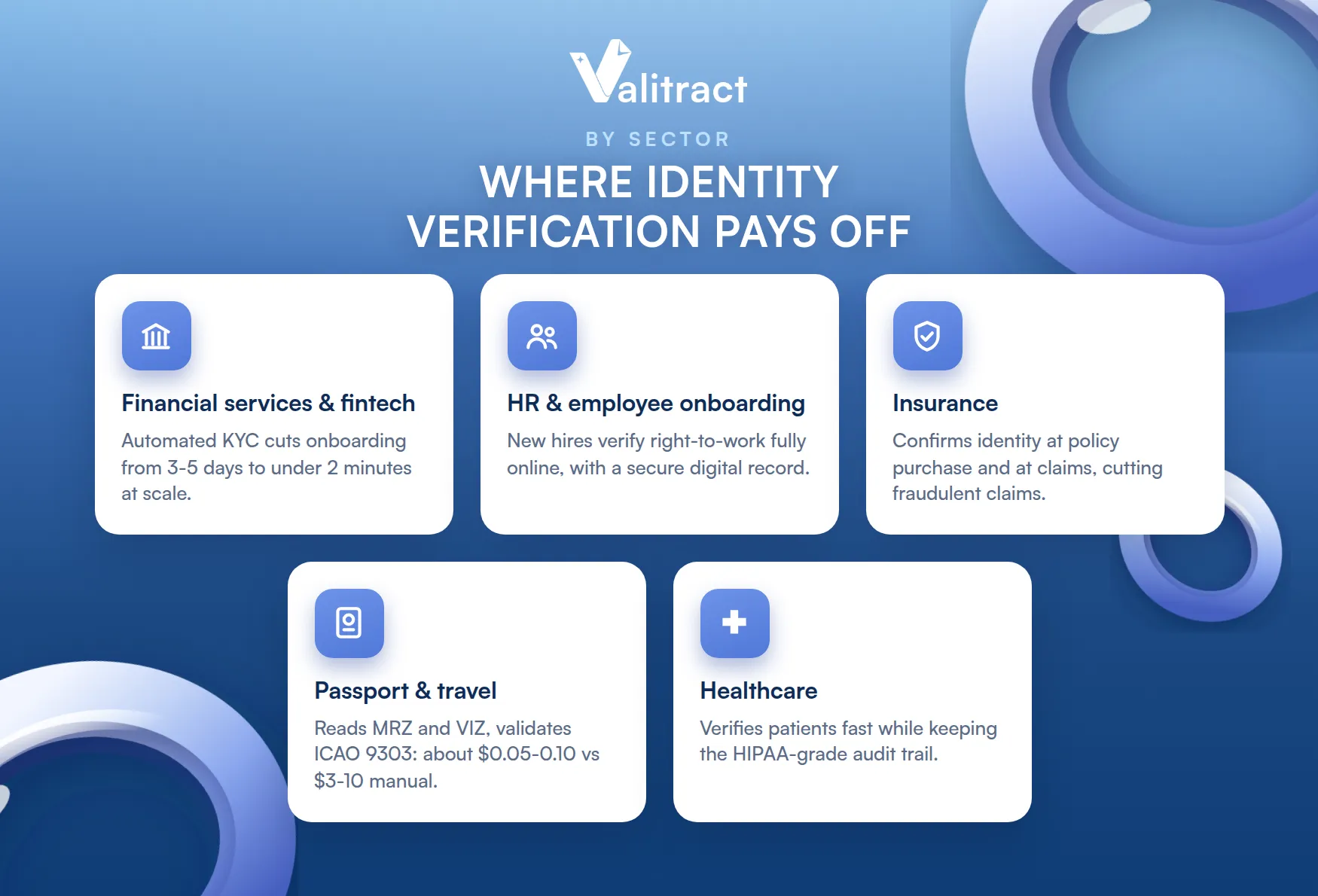
The payoff is largest wherever identity checks are high-volume, high-risk, or both. Five sectors stand out.
Financial Services and Fintech: KYC and AML Compliance at Scale
Banks and fintechs run automated KYC onboarding when customers open accounts or wallets. The pain is acute, with thousands of applications a day and regulatory deadlines on every verification.
The outcome is dramatic. Automation can cut onboarding from 3 to 5 days to under 2 minutes, and an AI identity verification platform paired with strong financial data extraction software keeps the data clean enough for compliance.
HR and Employee Onboarding: Right-to-Work Verification
HR teams verify the passports, visas, and work permits of new hires. Done by hand, each document is checked manually and often stored insecurely.
Automation makes this contactless and remote. New hires verify their right to work fully online, with no in-person meeting and a secure digital record, which is what contactless and remote ID verification tools deliver.
Insurance: Policy Application and Claims Identity Checks
Insurers verify identity both when a policy is bought online and when a claim is filed. The risk is fraudulent claims made with stolen identities.
Real-time validation reduces that exposure by confirming identity at both points, which lowers the fraudulent claims rate without slowing legitimate customers.
Passport and Travel
Travel, airlines, and border-adjacent services verify passports at high volume and speed. The pain is manual passport keying, which averages over 20 minutes per document and introduces errors.
Automation reads the passport in seconds. Dedicated passport OCR software reads the MRZ and visual zone together, validates checksums against the ICAO 9303 standard, and returns structured data at roughly $0.05 to $0.10 per document, against $3 to $10 for manual handling.
Healthcare: Patient Identity Verification
Healthcare providers verify patients when they book appointments or access medical records. The bar is high, since accuracy and HIPAA compliance are both mandatory.
Digital identity verification automation confirms the patient quickly while keeping the audit trail and data handling that healthcare regulations require.
Enterprise vs. SMB: Choosing the Right Level of Automation
The ideal identity verification setup depends entirely on your business scale: Enterprises require high-volume APIs with strict SLAs and custom integrations, while SMBs need a low-code, pay-per-verification setup.
What enterprise identity verification automation needs
Enterprises buy for scale and control. The checklist is a high-volume API with SLA guarantees around 99.9% uptime, custom machine-learning model training for internal document types, a full audit trail with SOC 2 and ISO 27001 compliance, integration with ERP, CRM, and HRMS systems, and dedicated support. These are the markers of enterprise identity verification automation tools.
What SMB and mid-market teams actually need
Smaller teams need speed and simplicity. The priorities are no-code or low-code setup with no developer required, pay-per-verification pricing rather than an enterprise contract, pre-built connectors for common tools, and fast time-to-value measured in days. This is what most customer identity verification automation vendors offer their mid-market buyers.
5 Questions to Ask Before Choosing a Vendor
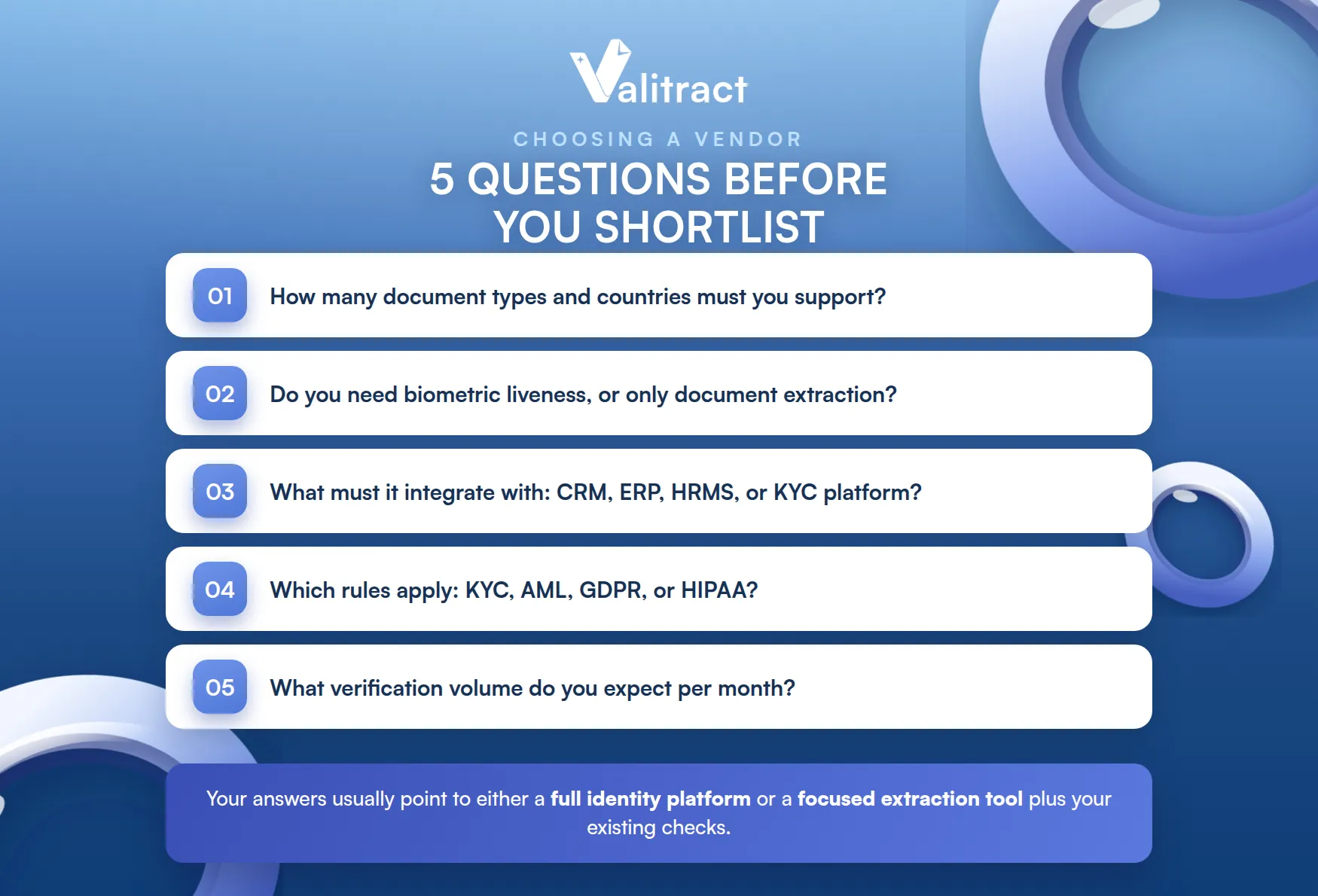
Answer these before you shortlist anyone:
- How many document types and countries do you need to support?
- Do you need biometric liveness detection, or only document extraction?
- What must the system integrate with, such as a CRM, ERP, HRMS, or KYC platform?
- What are your industry’s compliance requirements, across KYC, AML, GDPR, or HIPAA?
- What verification volume do you expect per month?
The answers usually point clearly to either a full identity platform or a focused extraction tool plus your existing checks.
Common Challenges in Implementing Identity Verification Automation
Automation is not plug-and-play. Four challenges come up in almost every rollout, and each has a known solution.
Handling Low-Quality or Damaged Documents
Real documents arrive blurry, torn, or glared from a phone camera. The fix is an AI pre-processing pipeline that deskews, denoises, and enhances contrast before extraction. A capable tool should still read a normal phone photo with 95% or better accuracy.
Supporting Global Document Formats
There are more than 10,000 document types across 190-plus countries, each with its own layout. Template-based tools fail the moment they meet a format they have not been configured for. A template-free visual AI approach handles any layout, which is the difference between a system that scales globally and one that constantly needs new templates.
Balancing Automation Rate With Accuracy
The real tension is between false positives, approving a fraudulent ID, and false negatives, rejecting a legitimate user. The optimal setup auto-approves high-confidence cases and routes edge cases to a human, aiming for an 85% to 95% straight-through processing rate on clean images.
Privacy and Data Compliance
Identity data is highly sensitive, so GDPR, CCPA, and data-residency rules all apply. The key questions for any vendor are where the data is processed and how long it is retained.
If your immediate gap is reading and validating identity documents accurately at scale, Valitract handles that layer, with template-free extraction, MRZ and VIZ validation, GDPR-aligned data handling, and SOC 2 Type II and ISO 27001 certifications in progress. Pair it with your biometric and screening checks to complete the stack.
How to Get Started With Identity Verification Automation
A staged rollout beats a big-bang switch. Three phases take you from audit to live with low risk.
Phase 1: Audit Your Current Verification Workflow
Map your current manual steps and bottlenecks. Identify which document types and volumes you handle, and estimate your current cost per verification so you have a baseline to measure against.
Phase 2: Define Your Automation Requirements
Decide what you actually need. Is this KYC-only or a full identity stack, API integration or a no-code platform, and what does your industry’s compliance demand? Clear requirements keep vendor demos focused.
Phase 3: Pilot and Measure
Start with a high-volume, high-confidence document type, such as a national ID with a clear image. Measure extraction accuracy, processing time, and exception rate against your baseline. An automated document extraction platform with a free tier lets you run this pilot on your own documents before you commit.
Conclusion: Automation Is No Longer Optional for Identity Verification
As automated identity verification becomes standard practice across industries, organisations require more than just faster document checks; they need scalable, accurate, and compliant verification workflows. The volume of onboarding, the sophistication of fraud, regulatory demands, and customer expectations have all grown beyond the capacity of manual review, making automation the norm rather than an optional extra.
The key takeaway is that automated identity verification is an integrated system, not a single product. It requires document AI to read and validate identity documents, verification logic to authenticate them, and workflow integration to automatically route decisions. Depending on the use case, additional layers such as biometric verification, sanctions screening, and fraud detection may also be required. Get the foundation right, and the rest of the verification process will become faster, more accurate, and easier to scale.
If your starting point is accurate and template-free identity document extraction and validation, Valitract can provide the document intelligence layer to power automated identity verification workflows. It reads identity documents in various formats, extracts structured data, and integrates seamlessly into your existing verification stack via a no-code dashboard or API.
Try Valitract free, or contact our team to see it in action with your own documents.
Frequently Asked Questions about Automated Identity Verification
What is Automated Identity Verification?
Automated identity verification is the use of AI and machine learning to confirm a person’s identity from their documents and biometrics, without manual review of every case. It captures the document, extracts and validates the data, matches the person to the document, and returns a decision in seconds. It replaces slow, inconsistent manual checks. The goal is faster onboarding with stronger fraud and compliance controls.
How Accurate is AI Identity Verification Compared To Manual Review?
AI verification is generally more accurate and far more consistent than manual review at volume, because it does not tire or vary between reviewers. Document data extraction reaches very high accuracy, and leading biometric matching hit a 97.5% true-positive rate in NIST’s 2025 evaluation. Manual reviewers, by contrast, make more errors under volume pressure. High-risk or low-confidence cases still route to a person for a final check.
Is Automated Identity Verification GDPR Compliant?
It can be, but compliance depends on the vendor and your configuration, not the technology alone. Look for GDPR-aligned data handling, clear data-retention controls, defined processing locations, and certifications such as SOC 2 and ISO 27001. You remain responsible for lawful basis, consent, and retention in your own use. Always confirm where data is processed and for how long it is kept.
What Documents Can Identity Verification Automation Process?
Modern systems process passports, national ID cards, driver’s licenses, residence permits, and supporting documents like utility bills and bank statements. The strongest tools read formats from 190-plus countries and multiple scripts, including Latin, Arabic, Chinese, and Cyrillic. They handle camera photos, scans, and PDFs. Template-free engines also read new or non-standard layouts without prior setup.
How Long Does Automated Identity Verification Take?
A typical automated check completes in seconds to under a minute, against minutes, hours, or even days for manual review. Document data extraction often runs in a few seconds per document. Deloitte’s 2025 Digital Identity Report found document verification AI cuts onboarding time by 45 to 60% for individual customers. Cases that need human review take longer, but they are the minority.
What’s The Difference Between Identity Verification and KYC Automation?
Identity verification confirms that a person is who they claim to be. KYC automation is broader: it includes that verification plus risk assessment, sanctions and PEP screening, and ongoing monitoring required by regulation. In other words, identity verification is one component inside a full KYC program. A complete compliance stack automates both.
Valitract – Next-gen AI-Powered Data Extraction Platform
- Email: contact@valitract.com
- LinkedIn: https://www.linkedin.com/company/valitract-api-platform
- X: https://x.com/valitract