


TL;DR
- Bank statement verification confirms that a statement is authentic and that its balances and transactions are real, not doctored.
- It matters most in lending, leasing, and compliance, where a forged statement can mean fraud, default, or a regulatory breach.
- Methods range from instant open banking authentication to micro-deposits and manual document checks, each with its own friction and risk.
- Automated, document-based verification extracts, cross-checks, and flags a statement in seconds, replacing slow manual audits.
A bank statement is the gold standard for proving financial health, and it is also the most vulnerable document in modern underwriting. Bank statement verification is what separates a real record from a convincing fake.
Lenders, landlords, and compliance officers lean on bank history to judge capital health. Cheap digital manipulation tools have made manual, eyeball verification close to obsolete.
A free afternoon and a basic design tool are now enough to alter a balance or invent a deposit. The reviewer who once trusted a clean-looking PDF can no longer afford to.
The stakes are not just a bad debt. A fraudulent approval can mean a regulatory penalty, a clawback, or a hole in the loan book that surfaces months later.
That is why automated, systemic verification is now a non-negotiable risk barrier rather than a nice-to-have. This guide explains what verification is, why it matters, the main methods, their limits, and how an automated process works.
What Is a Bank Verification Statement?
A bank verification statement is a bank statement that has been confirmed as genuine, with its account ownership, balances, and transactions validated as accurate rather than altered or fabricated. Confirming it is the process called bank statement verification.
The phrase gets used two ways. Bank statement verification is the process, while a bank verification statement is the trusted result that process produces.
Both hinge on the same evidence. A statement is only as trustworthy as the checks run against it.
Definition and Core Mechanics
At its core, verification answers one question: can this document be trusted as a true record of the account? Everything else is detail in service of that answer.
It checks three things in particular. The account must be real and active, the holder must match the applicant, and the figures must not have been edited.
Each check targets a different risk. Identity guards against impersonation, account status guards against closed or fake accounts, and figure integrity guards against tampering.
A statement can pass one check and fail another. A real account with a doctored balance is still fraud, which is why all three matter together.
Verification is therefore layered, not a single test. A statement earns trust only after clearing every layer.
Document-Based Verification vs Open Banking API Verification
There are two broad routes to a verified result. Document-based verification analyzes an uploaded statement, while open banking API verification connects directly to the bank.
- Document-based verification works with any PDF or scan a customer can produce. That makes it universal, but it leans on forensic and arithmetic checks to catch fakes.
- Open banking pulls data straight from the source through a secure connection. The data is tamper-proof because it never passes through the applicant’s hands.
The trade-off is coverage. Open banking only works for supported banks and users willing to log in and consent.
Cost and region matter too. Open banking availability varies widely by country, while a document can be uploaded from anywhere.
In practice, most teams use both. Open banking is the first choice where available, and document verification covers everyone else.
The two are complements, not rivals. A document fallback keeps coverage at full reach when open banking cannot connect to a bank.
Why Is Bank Statement Verification Critical?
Verification protects against fraud, satisfies regulators, sharpens underwriting, and speeds decisions. The case for it is operational as much as it is about compliance.
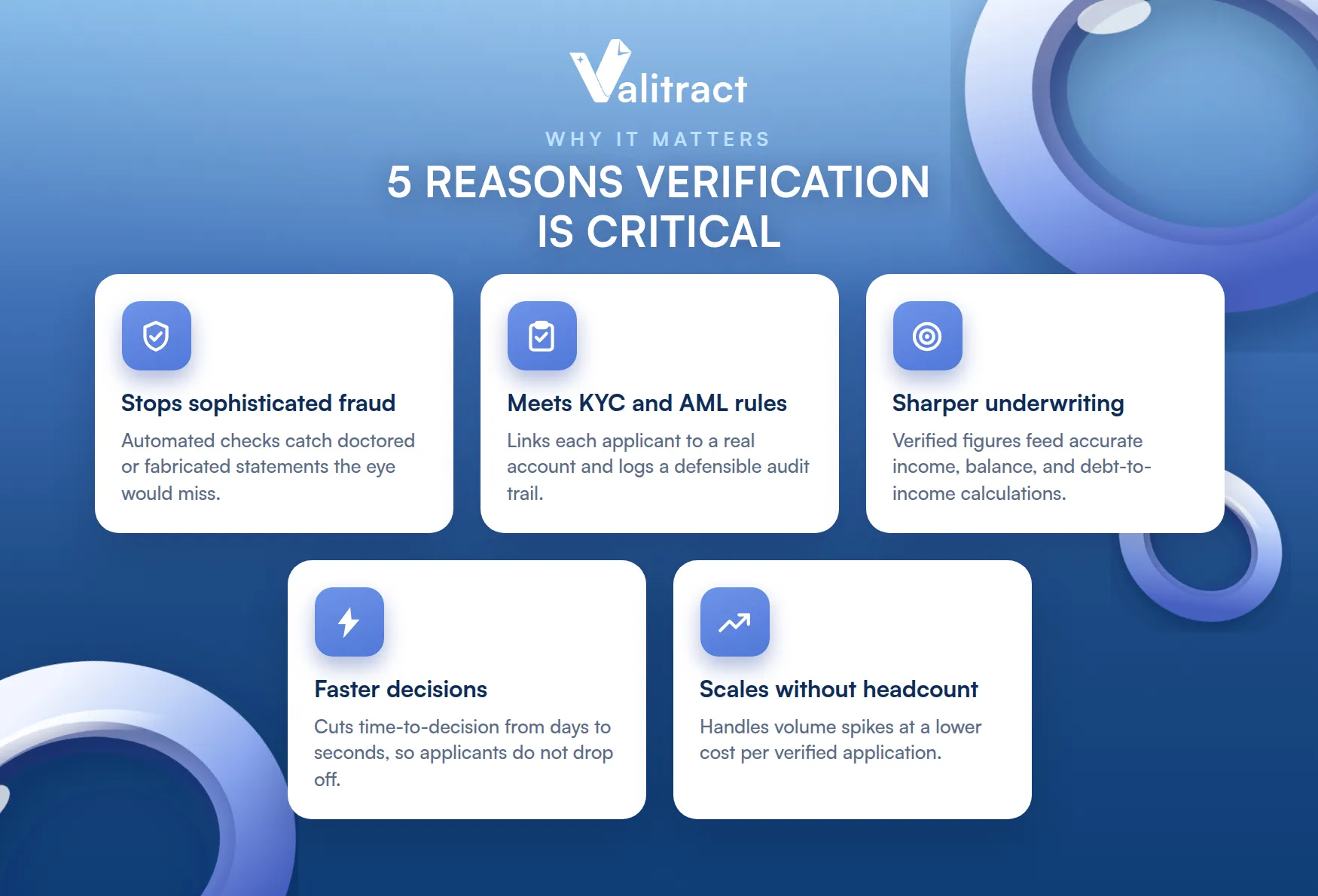
Five reasons stand out.
1. Mitigating Sophisticated Financial Fraud
Doctored, photoshopped, or fully fabricated statements are built to inflate a borrower’s creditworthiness. They are also getting harder to spot by eye.
Automated checks detect forensic anomalies at scale, catching fakes that a rushed human reviewer would pass. A misaligned font or an impossible running balance is invisible to a person but obvious to software.
The threat keeps rising as editing tools get cheaper and better. A verification layer that scales with volume is the only realistic defense.
Catching one fraudulent application can pay for the system many times over. The math favors prevention over cleanup.
2. Ensuring KYC and AML Regulatory Compliance
Anti-money-laundering and Know Your Customer rules require linking an applicant to a legitimate, active account. Verification establishes that link.
Just as important, it records how the link was made. That gives compliance teams a clean, defensible audit trail.
The trail matters as much as the check itself. When a regulator asks how an account was confirmed, the evidence is already on file.
That turns an audit from a scramble into a lookup. The record is built as a by-product of normal processing.
3. Eliminating Human Error and Maximizing Underwriting Precision
Manual data entry introduces typos and guesswork into risk calculations. A single transposed figure can change a lending decision.
Underwriting models need verified figures to compute net monthly inflows, average daily balances, and realistic debt-to-income ratios. Those metrics are only as good as the data behind them.
Garbage in means garbage out for any credit model. Verified, structured data is the foundation the whole decision rests on.
It also frees analysts from rekeying numbers. Their time shifts to judging the deal, not transcribing it.
4. Drastic Acceleration of Processing Speed
Manual auditing can take hours or days per file, especially when a reviewer has to chase missing pages. That delay is felt by every applicant in the queue.
Automated verification cuts time-to-decision from a day or more down to seconds. The pipeline keeps moving instead of stalling at the review step.
Speed is not only convenience; it is conversion. Every hour of delay loses applicants to a faster competitor.
Instant decisions also smooth demand spikes. A marketing push no longer overwhelms a manual review desk.
5. Enterprise Scalability and Cost Minimization
Automated systems let banks and fintechs handle far higher volume without adding headcount. The system absorbs the spike, not the hiring plan.
Fixed labor costs turn into predictable, lower marginal software fees. Cost grows with usage rather than with team size.
This is what makes growth affordable. A tenfold rise in applications no longer means a tenfold rise in reviewers.
Margins improve as volume climbs. The cost per verified application falls instead of holding flat.
Who Relies on Bank Statement Verification?
Any business that extends money, credit, or access based on a stranger’s finances needs verification. The use cases share one trait: a wrong call is expensive.
- Lenders and BNPL providers verify income and affordability before approving a loan or installment plan, since a fabricated statement can turn into a default.
- Landlords and property managers confirm that an applicant can cover rent, replacing the slow back-and-forth of chasing pay stubs.
- Fintechs and neobanks verify accounts during onboarding to satisfy KYC rules and to block fraudulent sign-ups at the door.
- Marketplaces and gig platforms confirm payout accounts and seller legitimacy before money starts to move.
The common thread is risk at the point of entry. Verification moves that risk check from a gut feeling to a documented, repeatable step.
Even adjacent teams benefit, from finance reconciling vendor accounts to operations confirming payout details. The same check serves many owners, which is why choosing the right bank statement verification software becomes increasingly important as your business scales.
Methods of Bank Account Verification
No single method fits every risk profile, so most teams combine a few. The taxonomy below, drawn from standard fintech frameworks like those of Plaid and TrueLayer, covers the field.
Each method trades speed, coverage, and security differently. Knowing those trade-offs is what lets a team match a method to a risk level.
Instant Authentication (Open Banking and OAuth)
The user logs into their bank through a secure widget, and verified data flows back in real time. Because the connection is direct, the data cannot be edited in transit.
This is the fastest and most tamper-resistant option. Its limit is coverage, since it only works for supported banks and users willing to consent.
It shines in markets with mature open banking. Where adoption is thin, its reach drops quickly.
Micro-Deposits (Pennies Matching)
The system sends one or two tiny deposits to the account, then asks the user to confirm the exact amounts a day or two later. Matching the amounts proves the user controls the account.
It is widely supported and cheap to run. The catch is friction, because the user has to leave, wait for clearing, and come back to finish.
It still suits lower-risk, less time-sensitive flows. For urgent approvals, the wait is a dealbreaker.
Manual Document Verification and Routing Checks
This is the traditional pairing of routing and account numbers with a physical or digital statement upload. A reviewer reads the document and cross-checks the details by hand.
It is universal, since anyone can upload a statement. It is also the slowest path and the most exposed to forgery when no automated forensics back it up.
This is exactly the method automation upgrades. The same upload becomes safe and instant once software does the checking.
Limitations of Traditional Bank Verification Methods
Older approaches carry real operational and security costs. Four limits recur, and they are the reason automation has taken over.
- High friction and churn: micro-deposits force users to log out, wait days, and return to finish. That delay causes heavy drop-off during onboarding.
- Administrative overhead: manual cross-checking creates backlogs and multiplies operating costs, much like rising invoice-processing costs in an overloaded finance team.
- Susceptibility to forgery: static PDFs and scans are easy to alter with common design software. A basic visual check rarely catches a careful edit.
- No continuous insight: a static statement is only a snapshot in time. It misses real-time non-sufficient-funds risk and any balance change after the upload.
Together these limits create a familiar bind. The safe manual route is slow, and the fast manual route is exposed, so automation is what breaks the trade-off.
These weaknesses compound at scale. What is a minor annoyance on ten applications becomes a serious cost and risk on ten thousand.
There is also a hidden cost in inconsistency. Two reviewers can reach different conclusions on the same statement, which is hard to defend in an audit.
Step-by-Step: The Automated Bank Statement Verification Process
A modern automated process runs in a fixed sequence, with each step feeding the next. Read it as a chain, since a weak step early on caps the quality of everything after it.
Here is how a statement moves from upload to a risk score.
- Multi-format document ingestion: the borrower uploads a PDF or phone photo through a secure portal, or grants consent to a direct open banking link. A capable document workflow automation software routes each file into the pipeline automatically.
- OCR layer extraction: computer vision and OCR pull flat text, structural tables, and metadata from the file without depending on a fixed layout. Engineers building this step often start with a best OCR API for developers for the baseline image parsing.
- Metadata and integrity forensic analysis: the platform inspects the file’s underlying architecture for visual alterations, editor software signatures, or font changes. A statement edited in a design tool leaves traces a forensic layer can flag.
- Arithmetic balance cross-checking: the system tallies every transaction row and validates day-over-day changes against the stated opening and closing balances. A statement that does not add up is flagged for review.
- Master verification and risk scoring: extracted account names and transaction histories are cross-referenced with external verification networks to calculate income and risk metrics. The output is a structured, scored record rather than a raw document.
The hardest steps are the forensic and arithmetic checks in the middle. Extraction is now close to a commodity, so trustworthy validation is the real differentiator.
A platform that extracts but never validates simply moves fraud downstream faster. The value is in catching the fake, not just reading it.
Done well, only genuinely uncertain cases reach a human. Clean statements clear automatically, and reviewers spend their time on the few that need judgment.
The handoff to a reviewer should carry context, not just a flag. A good system shows which check failed and why, so the human decision is fast.
What Red Flags Does Automated Verification Catch?
Verification is only useful if it catches the right problems. A good system flags a handful of telltale signs that a statement is fake or risky.
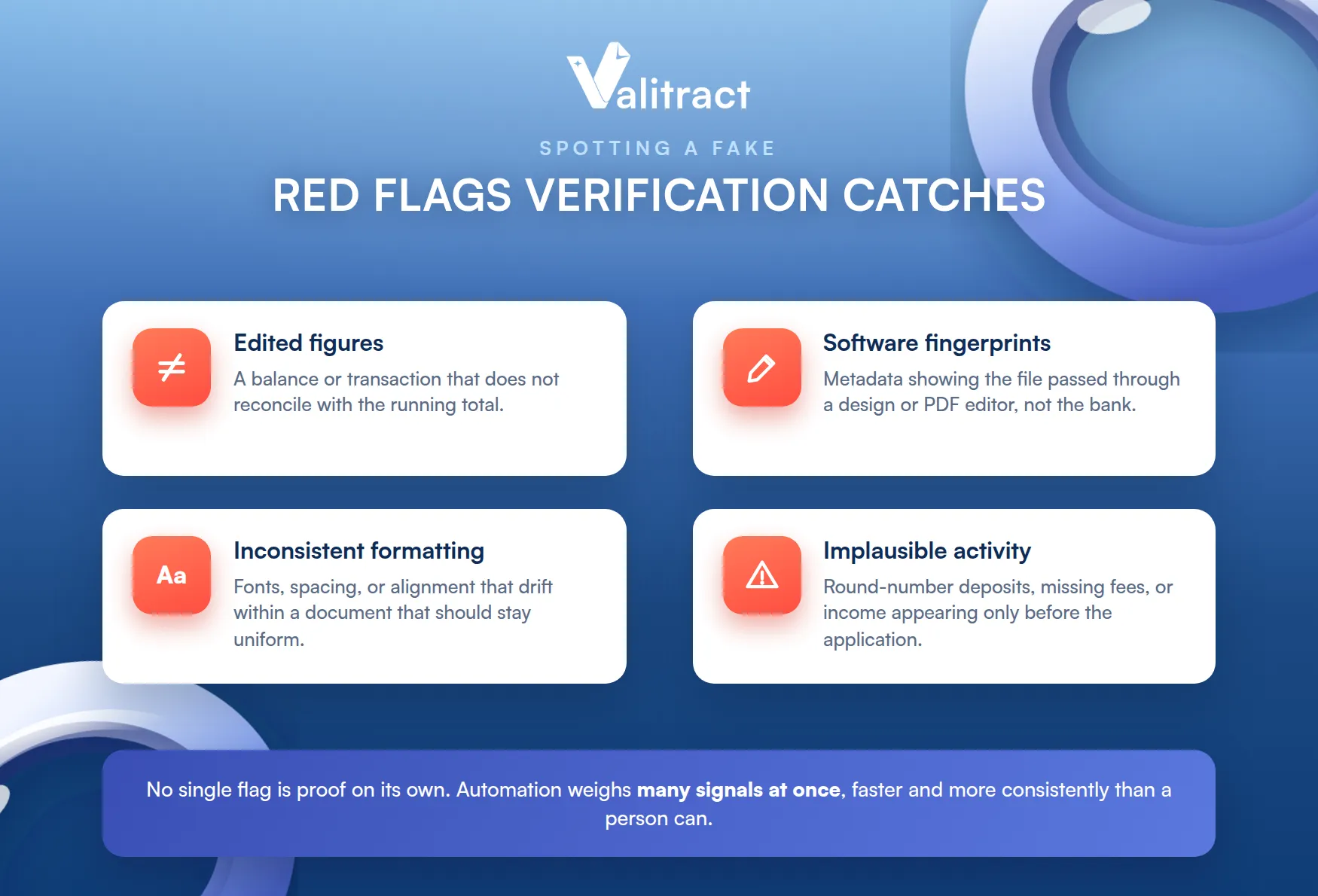
- Edited figures: a balance or transaction that does not reconcile with the running total, a classic sign of tampering.
- Software fingerprints: metadata showing the file passed through a design or PDF editor rather than the bank’s own system.
- Inconsistent formatting: fonts, spacing, or alignment that drift within one document, where a genuine statement stays uniform.
- Implausible activity: round-number deposits, missing fees, or income that appears only just before the application date.
No single flag is proof on its own. The strength of automation is weighing many signals at once, faster and more consistently than a person can.
Tuning matters here. Set the threshold too strict and good applicants get stuck; too loose and fakes slip through, so it is a business decision.
Materializing Automated Bank Verification with Valitract
Valitract handles the document side of this process as a template-free extraction and validation platform. It turns any bank statement, in any layout, into structured, validated data your risk systems can use.
On upload, Valitract extracts every field and transaction row, including multi-page statements, with accuracy of up to 99.8% and support for 95+ languages. It then runs arithmetic checks, confirming that transactions reconcile against the opening and closing balances.
Low-confidence fields and balance mismatches are flagged for human-in-the-loop review rather than passed through silently. The result is a faster document path, with a person stepping in only where judgment is needed.
The clean output feeds your scoring logic or open banking checks through a REST API. That lets Valitract complement network-based methods rather than replace them.
Validated data also flows on cleanly. Once a statement clears, its structured fields can post straight into a credit model or ledger.
Because it is template-free, a new bank’s layout works on the first upload with no setup project. That keeps the time from signup to a verified result short.
Pricing starts with a free tier, so a team can test it on real statements before committing. The point is to prove the workflow on your own documents first.
For teams that want to nail the extraction layer first, our guide to the best bank statement extraction software covers that step in depth.
Best Practices for Bank Statement Verification
Good verification is about process as much as technology. A few habits separate a reliable program from a leaky one.
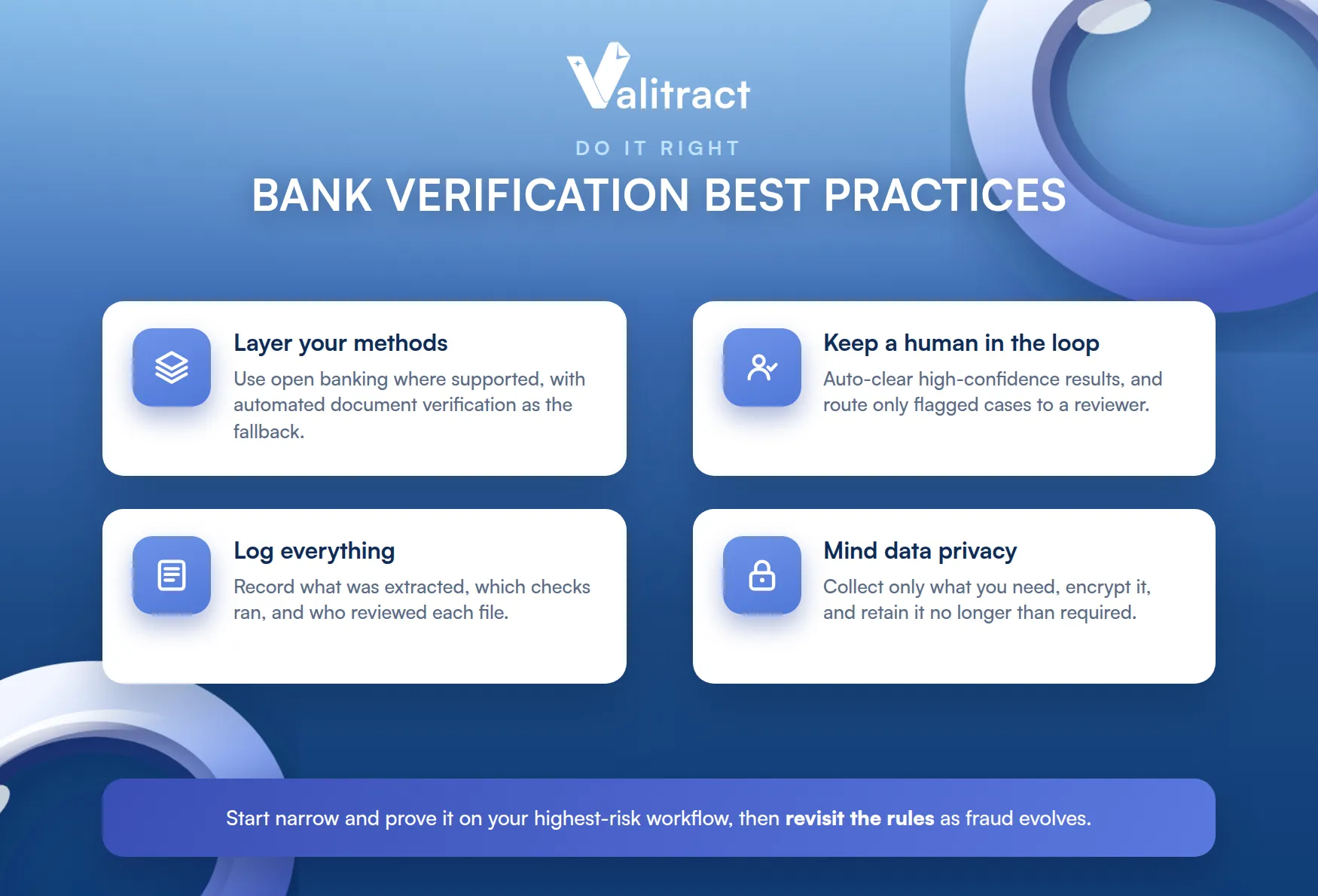
- Layer your methods: use open banking where it is supported and automated document verification as the universal fallback, rather than betting on one.
- Keep a human in the loop: auto-clear high-confidence results, and route only flagged or low-confidence cases to a reviewer.
- Log everything: record what was extracted, which checks ran, and who reviewed each file, so the audit trail builds itself.
- Mind data privacy: collect only what you need, encrypt it, and retain it no longer than the regulation requires.
Start narrow and measure. Prove the approach on your highest-risk workflow before rolling it out everywhere.
Finally, revisit the rules as fraud evolves. A check that worked last year may need tightening as new manipulation tricks appear.
Frequently Asked Questions About Bank Statement Verification
What is a bank verification statement?
A bank verification statement is a bank statement confirmed as authentic, with its account, balances, and transactions validated as genuine rather than altered. The act of confirming it is called bank statement verification.
How long does it take to verify a bank statement?
Manual verification can take hours or a day or two, especially with micro-deposits that require a waiting period. Automated document verification typically returns a result in seconds.
How do you verify a statement?
You can connect to the bank through open banking, use micro-deposits, or analyze an uploaded statement with automated extraction and forensic checks. Most teams combine methods based on risk and the banks they support.
Is it safe to share a bank statement for verification?
It is safe when the provider uses encryption, clear consent, audit logs, and minimal data retention. Always check that the platform aligns with regulations like GDPR before sharing financial documents.
Concluding Thought
Bank statement verification has shifted from a manual, trust-based check to an automated, evidence-based one. The documents are too easy to fake and the volume too high for the human eye alone.
The strongest setups combine methods: open banking where it is available, and automated document verification for everyone else. Whichever path you take, the goal is the same, to trust the data before you act on it.
Start with the workflow that carries the most risk or the most volume. Prove the time and fraud savings there, then extend verification across the rest.
Treat verification as living infrastructure, not a one-time setup. The threats change, and the system should change with them.
To automate the document side with template-free extraction and validation, explore Valitract.
Valitract – Next-gen AI-Powered Data Extraction Platform
- Email: contact@valitract.com
- LinkedIn: https://www.linkedin.com/company/valitract-api-platform
- X: https://x.com/valitract