


TL;DR
- Bank statement verification software confirms a statement is authentic, unaltered, and internally consistent, not just readable.
- Verification, extraction, and analysis are three different jobs; extracting a forged statement perfectly just launders a fake into clean data.
- The top tools split into two camps: open banking connections (Plaid, Yodlee) and document-based forensics (Floowed, MoneyThumb). Extraction layers like ValiTract are a separate, complementary category — see below.
- Choose on bank coverage, forensic depth, cross-document checks, API quality, and how cleanly the output lands in your stack.
Bank statements are the operational bedrock for judging capital health in modern business. Lenders, compliance teams, and credit analysts lean on that history every day.
The problem is that doctoring a statement has never been easier. A line-by-line edit in a PDF tool can produce a fake where the numbers add up, the logo is right, and the font looks correct at a glance.
That turns a manual visual audit into a liability rather than a control. The answer is programmatic automation, and the right bank statement verification software is what safeguards operations against increasingly sophisticated document fraud.
The stakes scale with volume. One missed forgery on a large loan can wipe out the margin earned on dozens of good ones.
This guide defines the category, compares the top five tools for 2026, and shows how to select and deploy one.
What Is Bank Statement Verification Software?
Bank statement verification software is a tool that automatically confirms a bank statement is authentic, unaltered, and internally consistent, using OCR, AI, and forensic checks. It extracts the data, reconciles the balances, flags signs of tampering, and routes suspicious files for review before they reach underwriting.
The emphasis is on trust, not just legibility. Reading the page is the easy part, while proving it is real is the hard part.
The category is often confused with simpler tools. The clearest way to understand it is to separate the three jobs that get lumped together.
Verification vs Extraction vs Analysis: Three Different Jobs
Financial document handling has three distinct layers, and blurring them leaves teams exposed.
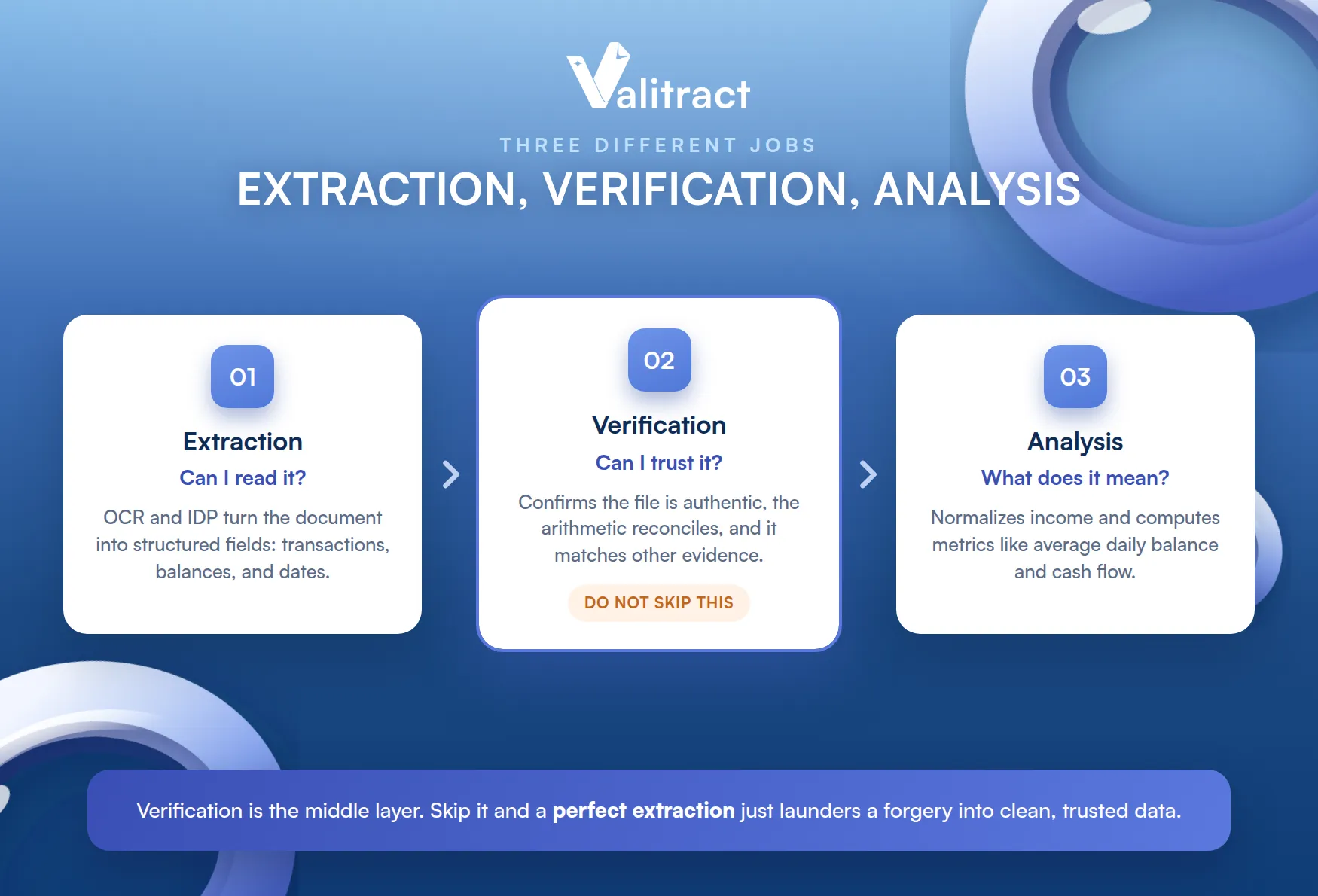
- Extraction turns the document into structured data. OCR and intelligent document processing read the transactions, balances, and dates into clean fields.
- Verification confirms the document can be trusted. It checks that the file is authentic and unaltered, that its arithmetic reconciles, and that it matches other evidence on file.
- Analysis interprets the data for a decision. It normalizes income and computes metrics like average daily balance, debt service coverage, and net cash flow.
Most teams need all three layers eventually. The mistake is buying one and assuming it covers the others.
The order matters because verification sits before analysis. A tool can extract every number on a forged statement perfectly and compute a flawless balance from fabricated transactions.
That is the trap. A perfect extraction of a tampered document is worse than useless, since it launders a forgery into clean, trusted data.
Good software does all three, but it never skips the middle one. Extraction without verification simply moves bad data faster.
This is why the shopping question is not just about accuracy. A tool that extracts at 99% but cannot tell a real statement from a fake leaves the biggest risk untouched.
Top 4 Bank Statement Verification Software Solutions
We assessed vendors on the benchmarks that decide real outcomes. Those are layout-agnostic parsing accuracy, forensic depth, straight-through processing speed, and API flexibility.
The four tools below split into two families. Two connect to the bank directly (Plaid, Yodlee), and two perform forensic checks on the uploaded document (Floowed, MoneyThumb).
The table below gives a quick orientation before the detailed breakdowns.
Table 1. Quick comparison of the top bank statement verification software in 2026.
| Tool | Verification method | Best for | Bank coverage | Tampering forensics | Cross-document validation | Evidence cross-check |
|---|---|---|---|---|---|---|
| Floowed | Document-based forensics plus decisioning | Lenders wanting read, analyze, and decide in one | Any format, including phone photos | Yes | Yes | Yes |
| Plaid | Open banking, direct bank connection | Instant, tamper-proof account verification | Thousands of US, CA, UK, EU banks | N/A, source data | N/A | Yes |
| Yodlee | Aggregation, live or uploaded | Global aggregation and long-term income patterns | Worldwide institutions | Limited | Some | Yes |
| MoneyThumb | Document-based parsing plus Thumbprint fraud | Fraud detection on uploaded statements | Uploaded PDFs, US focus | Yes | Some | Limited |
Source: vendor product and documentation pages, accessed June 2026. Confirm current capabilities and pricing before committing.
Two patterns jump out of the table. Open banking tools verify by connecting to the bank, while document tools verify by inspecting the file, and most mature programs use both.
2. Floowed
Floowed is a lending-focused platform that reads, verifies, analyzes, and decides on bank statements in one place. It is built for credit and risk teams rather than general finance.
Key features: a forensic layer that checks pixel patterns against known bank templates, validates routing numbers, reconciles running balances, verifies MICR encoding, and produces a composite risk score with plain-English explanations. It reads messy phone photos and handwritten documents, then runs cash-flow analysis and policy-based decisioning.
Pricing: enterprise, quote-based on volume and modules.
Pros: strong forensic depth, and the company reports catching 95%+ of forged statements. It connects to LOS, scoring, and KYC systems through 40+ integrations.
Cons: it is overkill for a finance team that only needs to read statements into accounting software, and pricing is enterprise-level.
Best fit: banks and fintech lenders that want reading, forensic verification, analysis, and decisioning in a single platform.
3. Plaid
Plaid is an open banking platform that connects directly to a user’s bank account rather than analyzing an uploaded file. Because data is pulled from the source, it cannot be edited in transit.
Key features: instant authentication, verified transaction, balance, and income data, and coverage across thousands of banks in the US, Canada, the UK, and parts of Europe.
Pricing: usage-based API pricing, with enterprise terms by quote.
Pros: tamper-proof data, instant results, and a developer-friendly API widely used by lenders, payment apps, and accounting platforms.
Cons: coverage is limited to supported banks and consenting users, and it does not verify uploaded documents, so it needs a document fallback for the rest.
Best fit: lenders and apps that want instant, source-of-truth verification wherever open banking reaches the customer’s bank.
4. Yodlee
Yodlee, part of Envestnet, is a long-standing financial data aggregation provider. It works through live bank connections or uploaded statements, depending on the use case.
Key features: aggregation across institutions worldwide, detailed transaction categorization, and historical depth for income verification, cash-flow analysis, and account monitoring.
Pricing: enterprise, quote-based.
Pros: broad global coverage and strong categorization, which helps when reviewing long-term income patterns rather than recent balances.
Cons: it is aggregation-first, so document tamper-forensics is not its focus, and onboarding is enterprise-weighted.
Best fit: global operations that need long-term income patterns and broad institutional coverage, not just a one-time check.
5. MoneyThumb
MoneyThumb is purpose-built for uploaded bank statements rather than direct bank integrations. It offers fast PDF parsing, data analysis, validation, and fraud detection through its Thumbprint product.
Key features: accurate PDF parsing, balance and transaction validation, and fraud detection that flags altered or fabricated statements. Its niche is clear, since for an upload-only pipeline a document-first fraud tool often beats a broader platform.
Pricing: subscription and usage-based, depending on product and volume.
Pros: a focused, document-first option for teams whose inputs are uploaded PDFs, with proven fraud detection.
Cons: it does not provide open banking connections, and coverage is strongest for US documents.
Best fit: lenders and brokers whose inputs are uploaded PDFs and who want focused fraud detection on those files.
Where ValiTract Fits: The Extraction Layer Behind Verification
Valitract is a template-free, AI-powered data extraction platform that turns any bank statement into clean, validated, structured data. It is the extraction and validation foundation that trustworthy verification depends on. You can see the platform at Valitract’s AI-powered data extraction.
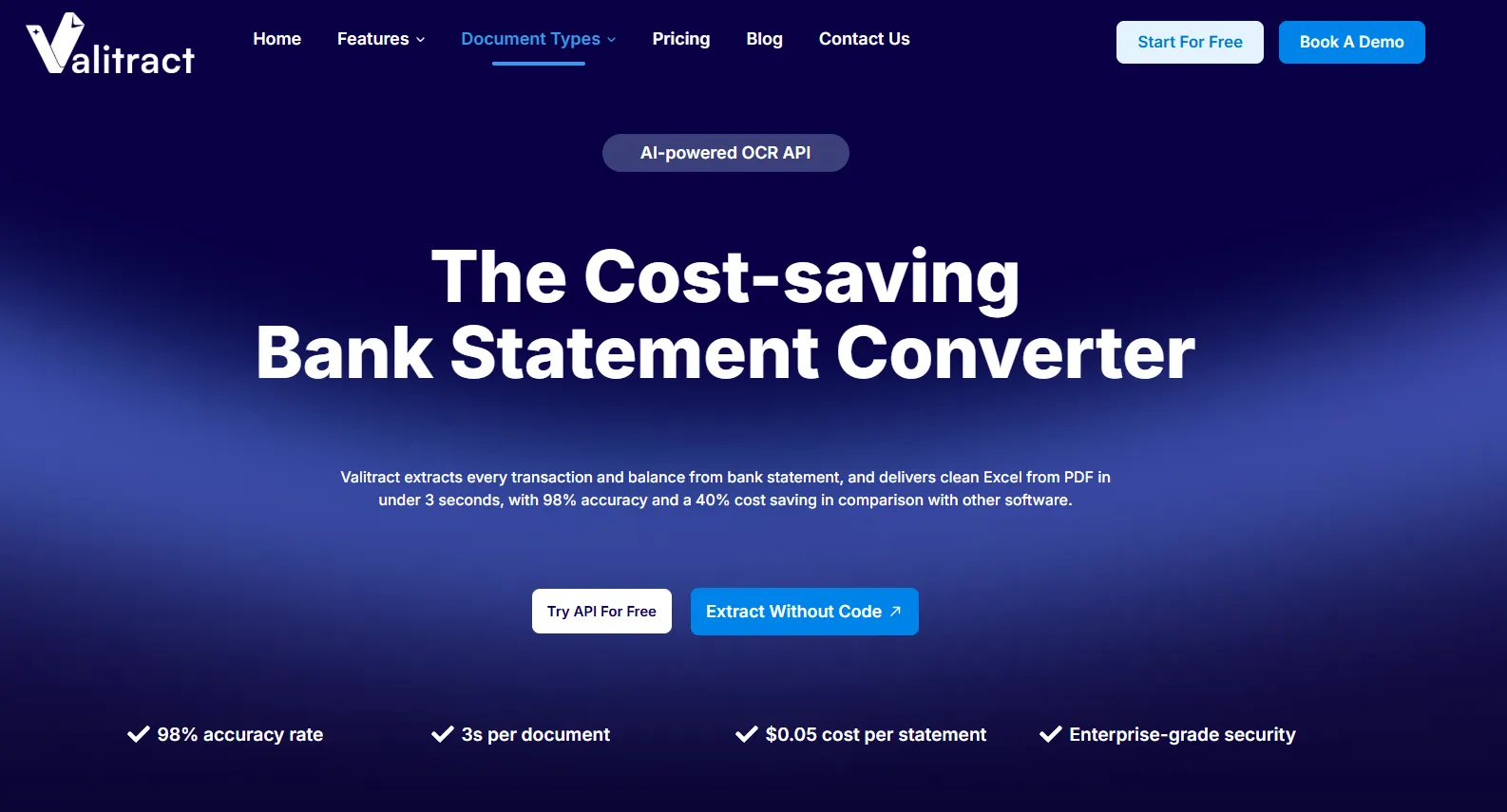
Key features: layout-agnostic parsing of any bank or format, including multi-page statements and phone photos. Arithmetic validation reconciles transactions against opening and closing balances, and low-confidence fields are flagged for human-in-the-loop review. Output is structured JSON through a REST API or a no-code dashboard, with support for 95+ languages. Because it is template-free, a new bank’s layout works on the first upload with no per-format setup to maintain.
Pricing: a free tier to start, then usage-based pricing as volume grows.
Pros: accuracy of up to 99.8% on standard documents, no templates to maintain, and clean output that drops straight into a risk stack. The Valitract bank statement converter also exports statements to Excel.
Cons: Valitract does not perform tamper or forgery detection. Its focus is on extraction, arithmetic validation and anomaly flagging, rather than open banking connections or deep file-metadata forensics. Pair it with these additional layers when full forensic verification is required.
Best fit: teams that need a fast, accurate extraction and validation layerto feed their own verification or scoring logic. Many teams building verific ation in-house start here rather than at the forensics layer, since clean extraction is the foundation everything else depends on.
Selecting the Right Bank Verification Software
The right choice comes down to engineering fit and business constraints, not a feature checklist. Weigh each vendor against how you actually work.
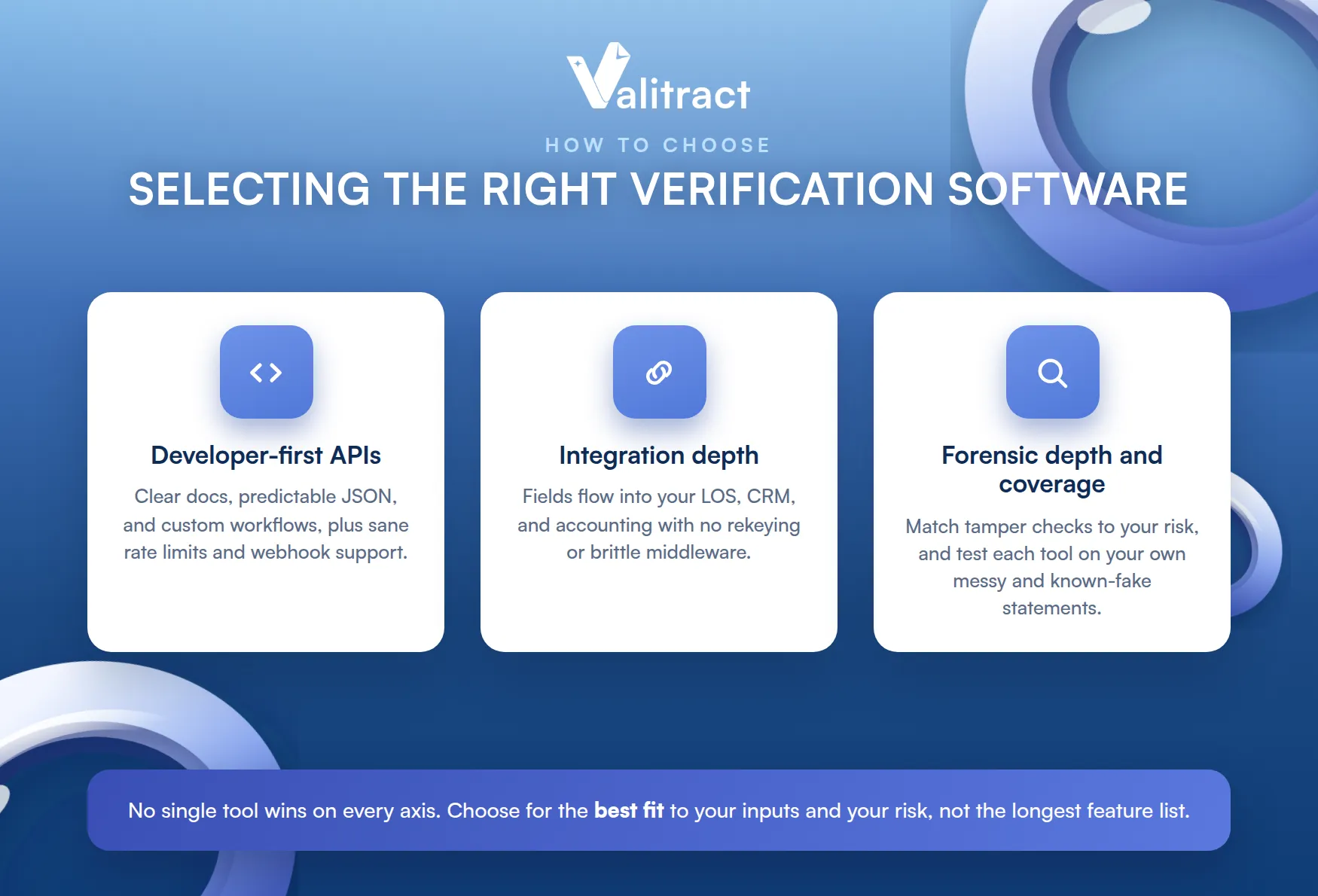
No single tool wins on every axis. The goal is the best fit for your inputs and your risk, not the longest feature list.
Developer-First APIs
Verification rarely runs in isolation, so the API matters as much as the model. Look for clear documentation, predictable JSON output, and the ability to build custom validation workflows around it.
Teams building this layer from the ground up should start by comparing the best OCR API for developers for the parsing foundation. A clean parsing layer is the base everything else sits on.
Watch for rate limits, payload shape, and webhook support too. The friction of integration is often where a project quietly stalls.
Platform Integration Depth
A verified result is only useful when it lands in the right system. Assess how smoothly extracted fields pass from the ingestion layer into your core accounting or loan origination software.
The goal is no rekeying and no brittle middleware. If the output is standardized JSON, one verification can feed your LOS, your CRM, and your data warehouse at once.
Ask to see the output schema before you buy. A messy or unstable JSON contract becomes your maintenance burden later.
Forensic Depth and Coverage
Match the forensic depth to your risk. A high-value loan justifies metadata and tamper checks, while a low-risk flow may only need balance reconciliation.
Coverage is the other axis. Test every tool on your own messy statements from your top source banks before you commit.
A demo on clean samples proves little. Your real applications are where a tool either holds up or falls over.
Keep a small set of known fakes too. The only way to measure fraud catch rate is to feed a tool documents you already know are forged.
Why Bank Statement Verification Software Matters
The business case is about protection and efficiency in equal measure. Three strategic pillars stand out.
Mitigating Fraud Losses
Manipulated and fabricated statements are designed to pass a quick human glance. The cost of missing them is real, since Alloy’s 2024 State of Fraud Benchmark Report found that 57% of financial institutions lost more than $500,000 to fraud in 2023, and about one in four lost over $1 million.
Automated verification stops those documents before they reach production databases. Catching a single forged application can pay for the software many times over.
The return is asymmetric. The software costs the same whether it catches one forgery or a hundred, while each catch protects a full loan.
Enforcing KYC and AML Lines
Verification links each applicant to a legitimate, active account and records how that link was made. The result is a clear, unalterable digital audit trail.
That trail satisfies federal compliance and banking mandates. When an auditor asks how an account was confirmed, the evidence is already captured.
That lowers both risk and stress. Compliance stops being a manual reconstruction and becomes a lookup.
Eliminating Operational Bottlenecks
Manual review is slow, inconsistent, and expensive at volume. Automating it removes the backlog and the human error that come with rekeying numbers.
The savings echo the dynamics behind invoice processing cost in finance teams. Labor turns into a predictable software fee, and staff shift from typing to judging exceptions.
Throughput climbs with no new desks. The same team clears far more files once the routine cases clear themselves.
Best Practices for Implementing Bank Statement Verification Software
Deployment is an operational lifecycle, not a plug-and-play install. The five stages below take you from ingestion to continuous optimization.
Treat each stage as a checkpoint, not a one-off. The system that ships in month one should not be the system running in month twelve.
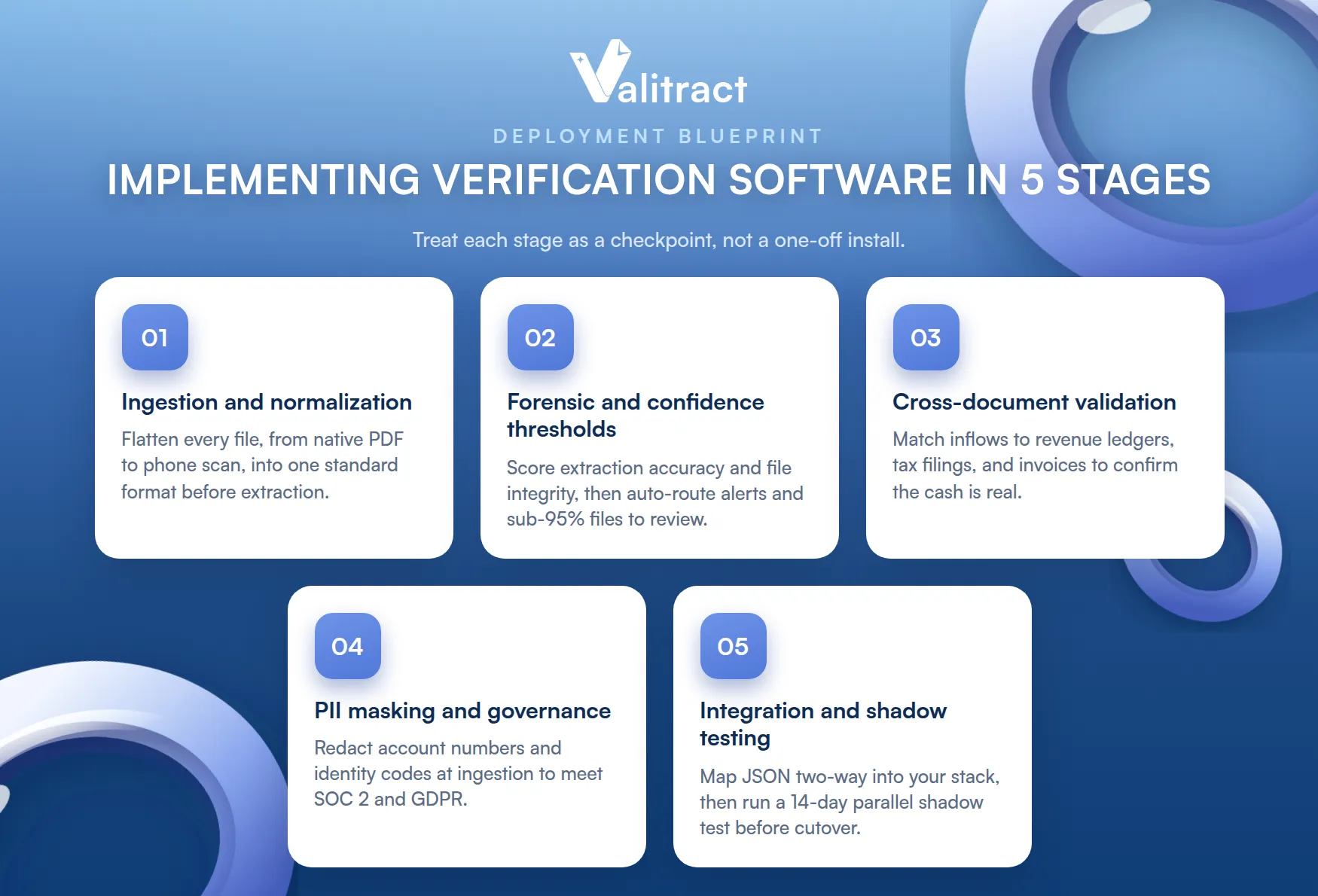
1. Establish Ingestion Pipelines and Format Normalization
Configure secure, multi-channel entry points such as API endpoints, client portals, and secure inboxes. Make sure the software flattens every incoming file, from a high-resolution native PDF to a low-DPI phone scan, into one standard format before extraction.
A clean, normalized input sets the ceiling for everything downstream. Garbage in still means garbage out.
Normalization also makes accuracy comparable across sources. A phone photo and a native PDF should reach the engine in the same shape.
2. Configure Forensic Risk and Confidence Thresholds
Define the boundaries for straight-through processing. Program the rules engine to calculate two scores, one for extraction accuracy and one for file integrity.
Any document that triggers a metadata alert, such as modified font tracking or editor signatures, should be isolated automatically. So should any file that falls below a 95% extraction confidence, which goes to a human-in-the-loop queue rather than to production.
The threshold is a business decision, not a technical default. Set it too high and reviewers drown, too low and fakes slip through.
3. Orchestrate Cross-Document Validation Logic
Build relational checks that test the statement against other financial proof. Match monthly inflows against revenue ledgers or tax filings to confirm the cash is real.
In B2B cases, align bank descriptors with issued invoices through automated invoice validation software. That confirms reported cash flows are backed by genuine commercial activity.
4. Deploy PII Masking and Data Governance Controls
To meet SOC 2, GDPR, and local banking rules, set up automated redaction profiles. The software should mask sensitive fields, such as full account numbers and national identity codes, at the ingestion layer before storage.
Masking early shrinks your exposure surface. Reviewers see only what they need to make the call.
Governance is not just a legal box. Tight data handling is also what lets you expand verification into more sensitive workflows later.
5. Execute Bidirectional Integration and Shadow Testing
Map the verified JSON output into your core stack, whether that is your loan origination system, CRM, or automated invoice processing hub. The integration should be two-way, so status and decisions flow back as well.
Before going fully live, run a 14-day shadow test. Process live documents in parallel with your legacy workflow to benchmark accuracy, surface edge-case bank formats, and tune out false positives.
Shadow testing builds trust before cutover. By the time you flip the switch, the team has already watched the system handle real traffic.
Frequently Asked Questions About Bank Statement Verification Softtware
What is the main difference between general OCR and dedicated bank statement verification software?
General OCR only reads text off a page and stops there. Bank statement verification software adds the layers that OCR lacks: it reconciles balances, checks for tampering, validates against other documents, and routes low-confidence files for review, so the output is trusted rather than just legible.
How does bank statement software catch digital document alterations?
It combines several checks: arithmetic reconciliation that catches balances that do not add up, metadata and font analysis that spot files touched by a PDF or design editor, and pattern matching trained on real and forged statements. No single signal is proof, so the system weighs many at once and assigns a confidence or risk score.
Why is data extraction alone not enough for financial underwriting workflows?
Because extraction will happily pull perfect numbers off a perfectly forged statement. Without verification, that fake data flows straight into your underwriting model as if it were real, which is why verification and validation have to sit between extraction and the decision.
Concluding Thought
The best bank statement verification software is the one that aligns with your requirements, risk profile, and existing systems. Open banking tools such as Plaid and Yodlee are effective where direct connections are available. Among document-based tools, Floored and MoneyThumb cover uploaded statements with built-in forensic checks, while ValiTract can be used as a foundation for a verification pipeline, whether based on one of these tools or your own.
Whatever you shortlist, remember that extraction is the foundation and verification is the safeguard. A clean, validated, structured statement is what every downstream decision depends on.
Start with your highest-risk or highest-volume flow. Prove the savings there, then widen the rollout from a position of evidence.
To build that foundation with template-free extraction and arithmetic validation, explore Valitract’s AI-powered data extraction.
Valitract – Next-gen AI-Powered Data Extraction Platform
- Email: contact@valitract.com
- LinkedIn: https://www.linkedin.com/company/valitract-api-platform
- X: https://x.com/valitract