


Your accounts payable team may be spending up to $15 to process a single paper invoice, and most finance managers have no idea. That figure is not the software license or the bank transfer fee. It is the fully loaded cost: the labor hours, the error corrections, the approval chasing, and the infrastructure holding it all together.
Invoice processing cost is one of the most undercounted line items in finance operations. A company processing 500 invoices per month at $12 per invoice spends $72,000 annually on a task that automation handles for a fraction of that. The opportunity is significant, but capturing it requires knowing your actual cost first.
This guide gives you the 2026 industry benchmarks, a detailed calculation framework, and the specific strategies that reduce invoice processing cost without cutting corners.
TL;DR
Manual invoice processing costs between $9.87 and $15.00 per invoice, according to Levvel Research and APQC benchmarks. Businesses with full automation bring that down to $2.81 or less. The gap comes from labor, errors, approval delays, and hidden infrastructure costs that most finance teams never measure. This guide breaks down every cost component, shows you how to calculate your actual per-invoice cost, and outlines the automation strategies that produce the highest savings.
What Is Invoice Processing Cost?
Definition of invoice processing cost
Invoice processing cost is the total financial and operational expense a business incurs to handle one invoice, from receipt through to payment and storage. It includes direct labor, technology, error correction, transaction fees, and the cost of delays.
Hard costs vs. soft costs in accounts payable
Invoice processing costs split into two categories, and most businesses only track one of them.
Hard costs are the line items that appear in budget reports. These include software subscriptions, payment transfer fees, paper and printing supplies, postage, and physical storage space for paper records. Hard costs are visible and easy to audit.
Soft costs are harder to see but often larger in total. These include the hours your accounting staff spend on manual data entry, the time managers spend reviewing and approving invoices, and the business opportunities lost when slow processing delays a project or strains a vendor relationship. Most AP teams undercount soft costs by 40–60% because no one tracks time at the per-invoice level.
Benchmarking Your Invoice Processing Costs: Where Do You Stand?
Industry data shows a wide spread in invoice processing costs, from under $3 to over $15 per invoice depending on how automated the invoice process in a company’s AP function is.
The wide spectrum of invoice processing costs
The spread in per-invoice costs reflects three structural factors.
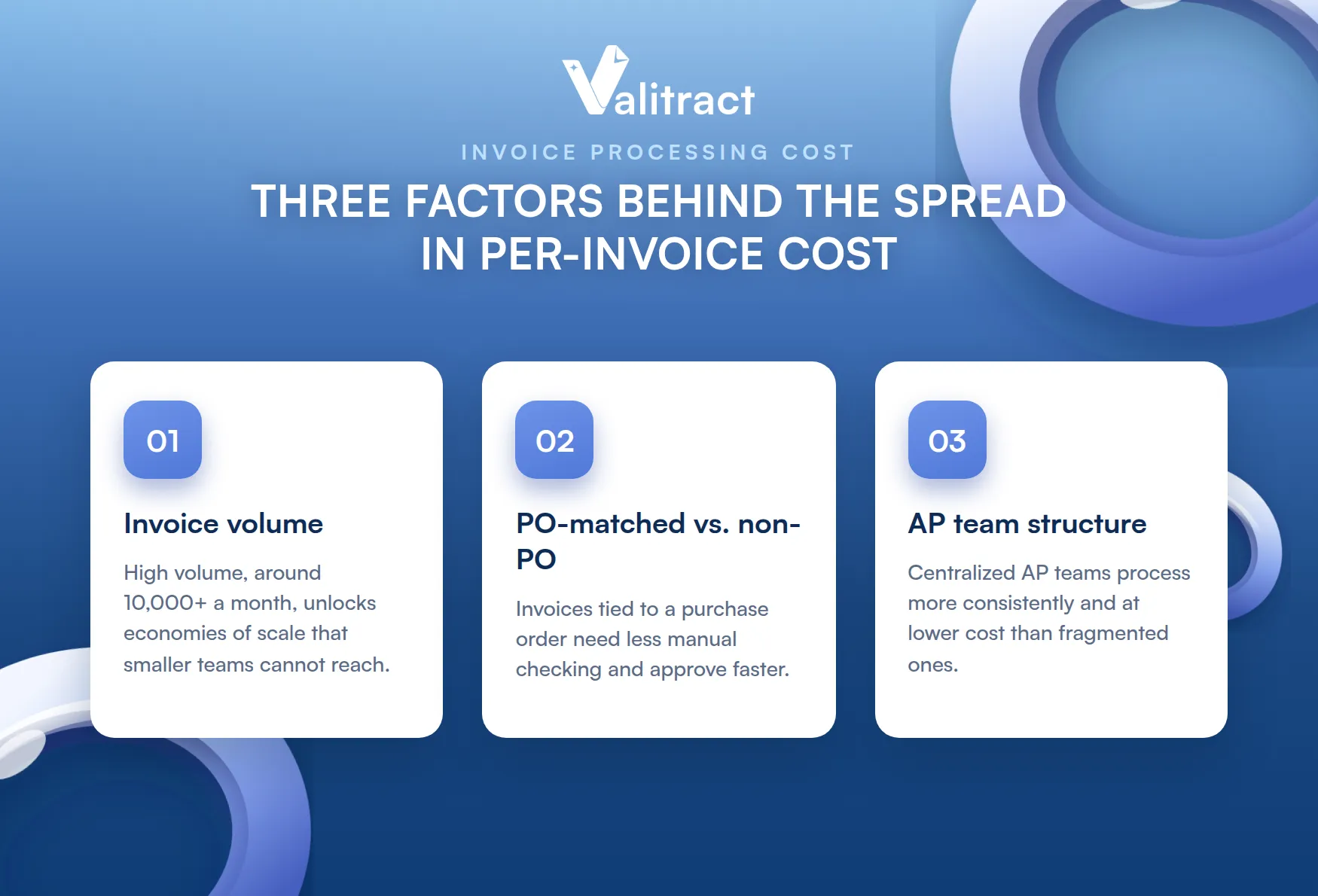
First, invoice volume: companies processing 10,000 invoices per month achieve economies of scale that smaller teams cannot. Second, PO-matched vs. non-PO invoices: invoices tied to a purchase order require less manual verification and approve faster. Third, AP team structure: centralized AP departments process invoices more consistently and at lower cost than fragmented teams spread across business units.
A company with 200 invoices per month, mostly non-PO, handled by two part-time staff in different offices will have a fundamentally different cost profile than a mid-size manufacturer with 5,000 monthly invoices running through a centralized ERP.
Industry benchmarks: optimal vs. average cost
According to Levvel Research and APQC, the average manual invoice processing cost sits between $9.87 and $15.00 per invoice. Companies with full AP automation bring that down to $2.81 per invoice or below.
The table below shows how processing cost and cycle time differ between low-automation and high-automation AP teams.
Metric | Low-tech (manual) | High-tech (automated) | Source |
Average cost per invoice | $9.87–$15.00 | $2.81 or less | Levvel Research, APQC |
Invoice cycle time | 10–14 days | Under 24 hours | IOFM, 2024 |
Error rate | 3–5% of invoices | Under 1% | Aberdeen Group |
Early payment discount capture rate | Below 20% | Above 70% | IOFM |
The cycle time gap is as consequential as the cost gap. At 10–14 days per cycle, manual AP teams miss early payment windows, accumulate late payment penalties, and create friction with vendors who expect faster turnaround.
How to Calculate Your Manual Invoice Processing Cost
Most businesses estimate their invoice processing cost using a rule of thumb. That estimate is almost always too low.
The pitfall of generic estimation (the 30-minute rule)
The most common approximation in finance operations is this: one manual invoice takes 30 minutes of staff time. At an AP specialist’s fully loaded labor rate of $24–$70 per hour (depending on role level and region), that puts the per-invoice cost at $12–$35.
The problem is that 30 minutes captures only the data entry step. It ignores the time spent on PO matching, approval routing, exception handling, payment reconciliation, and storage. For a typical mid-size company, the actual staff time per invoice is closer to 45–75 minutes once all tasks are counted.
The deep-dive framework: tactical, abstract, and hidden costs
A more accurate calculation requires breaking down every task your team performs for each invoice.
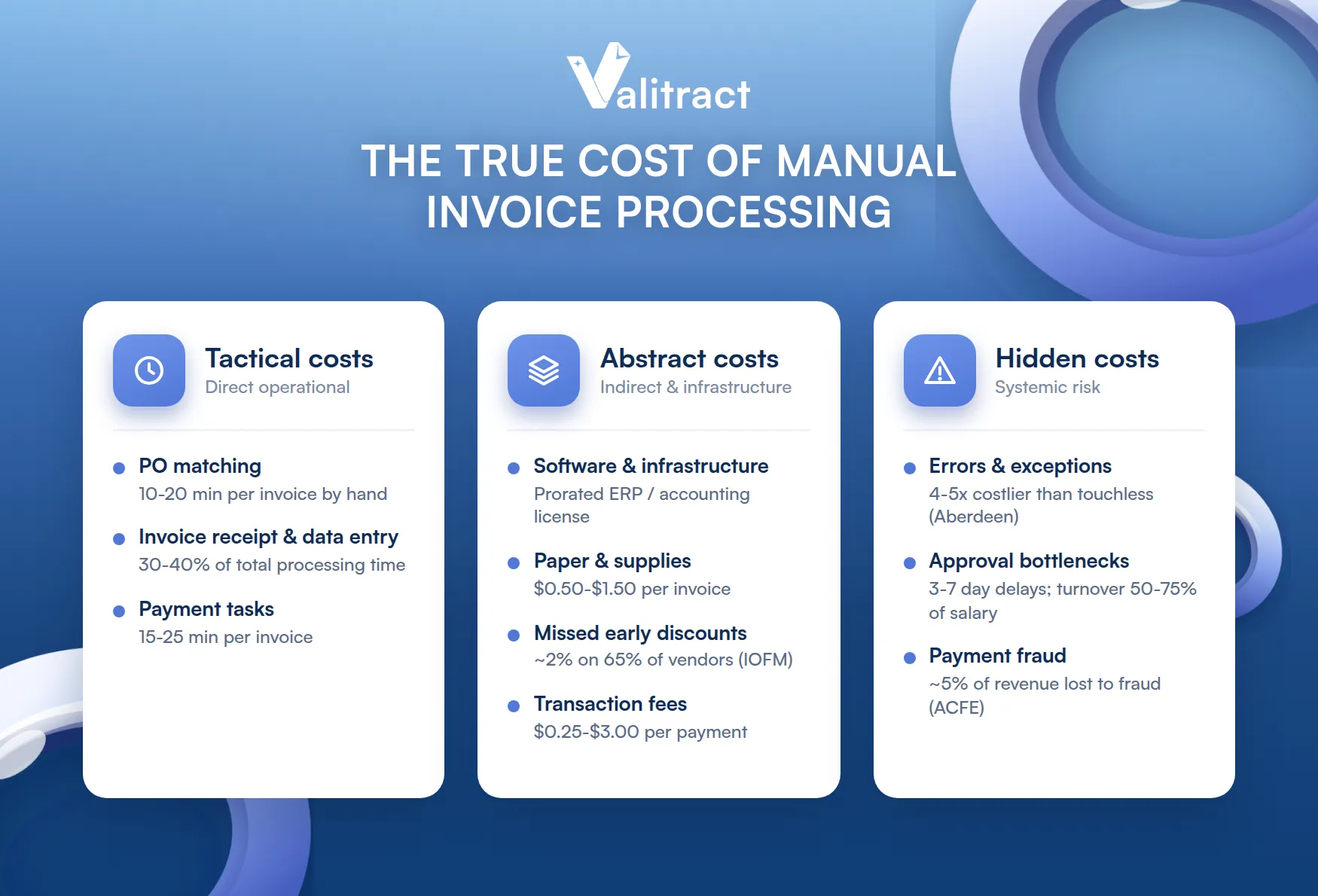
The framework below organizes these into three layers.
1. Tactical costs (direct operational expenses)
These are the time-based tasks that your AP team completes in a linear sequence for every invoice. Multiply hours by fully loaded labor rate to calculate the cost per invoice.
- Purchase orders: Creating purchase requisitions, routing POs through approval, sending POs to vendors, and manually matching the PO to the incoming invoice. Matching alone takes 10–20 minutes per invoice when done by hand.
- Invoice processing tasks: Receiving invoices across channels (email, mail, fax, vendor portals), manually keying data into your accounting system or ERP, routing invoices through the approval workflow, and following up with managers who have not signed off. Invoice receipt and data entry typically account for 30–40% of total processing time.
- Payment tasks: Compiling aged payables reports, reconciling invoices against payment batches, gathering supporting documents, executing bank transfers, and completing bank reconciliation. Payment processing adds 15–25 minutes per invoice on average.
To calculate your tactical cost per invoice:
List every task performed per invoice and estimate the average time per task.
Add all task times to get total minutes per invoice.
Divide by 60 to get hours.
Multiply by the fully loaded hourly rate of the staff member performing the task (salary plus benefits plus overhead, typically 1.25–1.4x base salary).
2. Abstract costs (indirect and infrastructure expenses)
These costs do not appear in your AP staff’s time log, but they accumulate with every invoice processed.
- Infrastructure: Your ERP or accounting software license, prorated to the AP function. If your ERP costs $2,000 per month and the AP team accounts for 20% of usage, that is $400 per month allocated to invoice processing.
- Supplies: Paper, ink cartridges, envelopes, and postage for any paper-based invoicing or archiving. For companies still handling paper invoices, this commonly runs $0.50–$1.50 per invoice.
- Missed vendor discounts: This is a pure opportunity cost. According to IOFM, 65% of vendors offer early payment discounts of approximately 2%. Manual processing is too slow to capture these discounts consistently. For a company paying $500,000 in supplier invoices per month, missing a 2% discount represents $10,000 in foregone savings every month.
- Transaction fees: Bank transfer fees, ACH processing fees, and credit card processing charges add $0.25–$3.00 per payment depending on payment method.
3. Hidden costs (systemic risks and difficult-to-measure losses)
These costs are the hardest to quantify and the most damaging if left unaddressed.
- Human error and exception handling: When a data entry error occurs, such as a transposed digit in a vendor ID or an incorrect line-item amount, correcting it requires re-opening the invoice, tracing the error, correcting the record, and re-routing for approval. According to Aberdeen Group, exception handling costs four to five times more per invoice than straight-through processing. For companies with a 3–5% error rate, this can add $1.50–$4.00 per invoice to the average.
- Approval bottlenecks and staff burnout: Invoices waiting in manager email inboxes for 3–7 days are a standard occurrence in manual AP environments. Your accounting staff spend real time chasing approvals: sending reminders, escalating to department heads, and manually tracking which invoices are pending. This approval friction is a leading cause of AP staff turnover, which carries its own replacement and training costs (typically 50–75% of annual salary for a mid-level accounting role).
- Payment fraud: Manual AP processes lack the systematic cross-checks that catch duplicate invoices, altered bank details, or fictitious vendor invoices. Research from the Association of Certified Fraud Examiners estimates that businesses lose approximately 5% of annual revenue to fraud, with billing fraud among the most common types. A single fraudulent invoice that clears payment can exceed the annual cost of an automation tool.
The Hidden Breakdown: What Drives Up the Cost of Invoice Processing?
Several interconnected factors compound the basic labor cost of manual invoice processing.
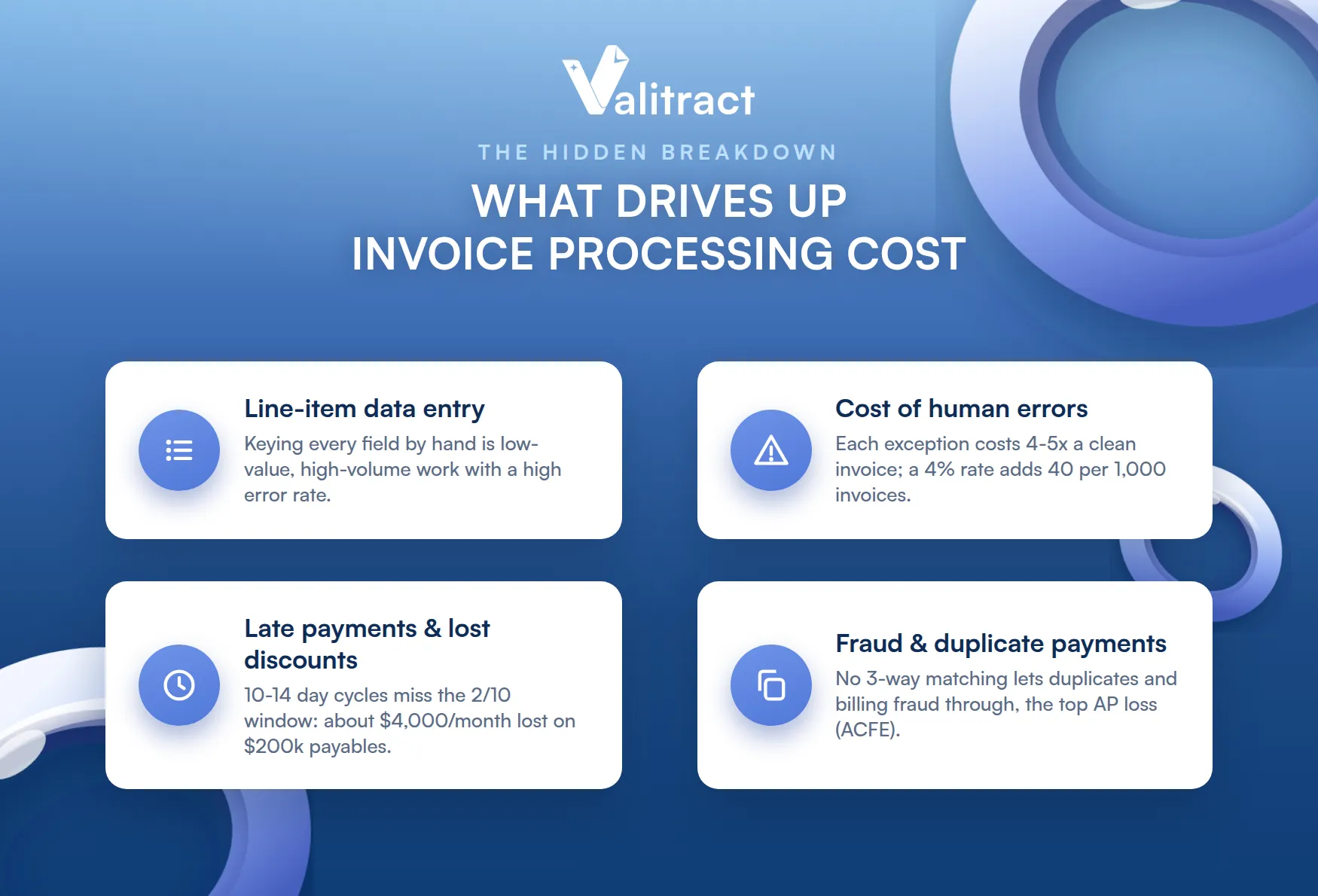
- Labor costs from line-item entry: AP staff in manual environments spend a significant portion of their day keying invoice data field by field: vendor name, invoice number, date, line items, totals, tax amounts. This is low-complexity, high-volume work that generates no analytical value. It also carries a high error rate because human attention degrades over repetitive tasks.
- The cost of human errors: When an invoice enters the exception queue because of a data entry mistake, a mismatched PO number, or a duplicate submission, it requires four to five times the processing effort of a clean invoice. At scale, a 4% error rate on 1,000 monthly invoices means 40 exceptions, each consuming an additional 45–60 minutes of staff time.
- Late payment penalties and lost discounts: Manual approval cycles average 10–14 days. Vendor payment terms frequently run net-30 with a 2% discount for payment within 10 days. When approval takes 12 days, the discount window is already closed. When approval takes 22 days, you are approaching the penalty zone. For a business with $200,000 in monthly payables, missing early payment discounts costs $4,000 per month in foregone savings.
- Invoice fraud and duplicate payments: Without automated three-way matching (invoice against PO against receipt), duplicate invoices are common. A vendor submitting the same invoice twice, or an internal staff member processing the same invoice from two channels, results in a double payment that can take months to recover. According to ACFE, duplicate payments and billing fraud together account for the largest share of financial losses in AP departments.
Proven Strategies for Automated Invoice Processing: Reducing Costs with AI
Automation does not replace your AP team. It eliminates the low-value, high-effort tasks that prevent your team from doing meaningful financial work.
Eliminate manual data entry with AI OCR
AI-powered OCR extracts structured data from any invoice format in seconds: vendor name, invoice number, line items, totals, tax amounts, and payment terms. This eliminates the manual keying step entirely and reduces data entry labor by 70–80% for most finance teams.
Unlike template-based extraction systems that require you to configure a separate layout for each vendor, AI-based tools handle new invoice formats automatically. You do not need to build a template for every supplier. The model adapts to the document.
If your team currently processes invoices by hand, the comparison between manual and automated data entry shows exactly where time is lost and how AI reallocation changes the workload.
Automate the approval matrix
Automated approval routing sends each invoice to the right approver based on vendor, amount, cost center, or department, without anyone manually forwarding an email. When the approver receives a notification, the invoice is already attached, pre-populated, and ready for a single-click decision.
This reduces average cycle time from 10–14 days to under 24 hours for straight-through invoices. Exceptions get escalated automatically rather than sitting in an inbox.
Valitract’s automated invoice processing includes configurable approval workflows that your team can set up without writing code. Define your approval matrix once, and the system routes every future invoice accordingly.
Implement cloud-based document storage
Physical invoice storage costs money to maintain and creates risk. Locating a specific invoice from 18 months ago for an audit requires manual searching through filing cabinets or inconsistent folder structures.
Cloud storage eliminates printing, filing, and retrieval costs. It also creates a searchable, timestamped audit trail that satisfies compliance requirements without additional effort from your team. For most AP departments, moving to digital storage saves $0.50–$1.50 per invoice in supply and labor costs alone.
The AI impact on total AP cost
Companies that fully automate their accounts payable function using AI-powered tools report 80–85% reductions in total AP operating cost in the first year of deployment. That figure comes from eliminating data entry labor, reducing error rates below 1%, capturing early payment discounts, and removing physical infrastructure costs.
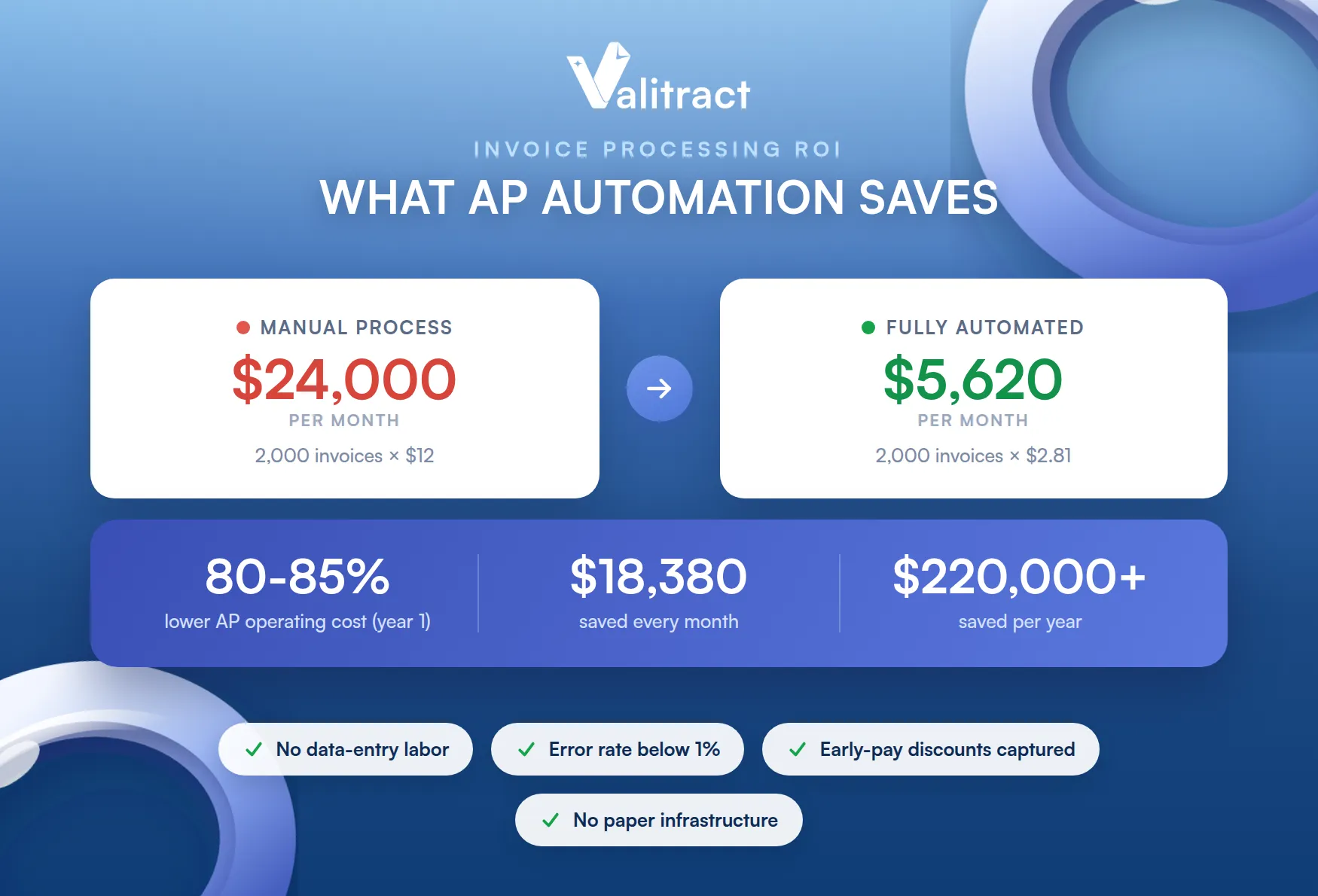
A finance team processing 2,000 invoices per month at $12 per invoice currently spends $24,000 monthly on AP operations. At the automated benchmark of $2.81 per invoice, the same volume costs $5,620 per month. That is $18,380 saved every month, or over $220,000 per year, before factoring in fraud prevention and recovered early payment discounts.
The AI invoice processing cost is totally net-positive for businesses of all sizes. For more detail on the full software landscape, see the best invoice processing software options currently available for teams at different volume levels.
Frequently Asked Questions about Invoice Processing Cost
What is the average manual invoice processing cost for businesses?
The average cost to process an invoice manually is between $9.87 and $15.00, according to Levvel Research and APQC. This range reflects the total cost of labor, error correction, approval routing, transaction fees, and infrastructure. Companies with higher invoice volumes and more structured AP departments sit toward the lower end. Smaller teams with fragmented processes often exceed $15.00 per invoice once all cost components are included.
How much invoice processing cost savings can automation provide?
Full AP automation typically reduces per-invoice costs by 70–80%, bringing the average from $9.87–$15.00 down to $2.81 or less. Companies processing 1,000 or more invoices per month commonly report annual savings of $100,000–$250,000 once labor, error handling, missed discounts, and infrastructure costs are accounted for. The highest savings come in the first year, when manual labor costs are replaced by automated extraction and approval workflows.
What hidden factors drive up the total cost of invoice processing?
Three hidden factors account for the largest share of untracked AP cost. First, exception handling: invoices with errors cost four to five times more to process than clean invoices because they require manual investigation and re-routing. Second, missed early payment discounts: slow manual cycles prevent teams from capturing 2% discounts that 65% of vendors offer for early payment, according to IOFM. Third, payment fraud: duplicate invoices and billing fraud go undetected longer in manual environments, and the average annual loss from financial fraud is approximately 5% of revenue, according to the Association of Certified Fraud Examiners.
How can I calculate my company’s invoice processing cost without an online tool?
Calculate your per-invoice cost using four inputs: (1) total AP staff hours spent on invoice-related tasks per month, multiplied by fully loaded hourly labor rate; (2) monthly infrastructure costs prorated to AP (software, storage, supplies); (3) estimated monthly losses from missed discounts and late fees; (4) estimated error handling time. Add all four and divide by the number of invoices processed per month. Most teams find their actual cost is 30–50% higher than their initial estimate because they undercount steps 2 through 4.
How much do automated invoice processing tools cost?
Automated invoice processing tools range from free tiers for low-volume users to enterprise contracts for large organizations. Entry-level plans with basic AI extraction typically start around $50–$150 per month for up to a few thousand pages. Mid-tier plans with approval workflow automation, ERP integrations, and API access range from $200–$800 per month. Enterprise plans with fraud detection, high-volume capacity, and dedicated support are priced on contract. Most companies recoup the tool cost within the first 1–3 months through labor savings alone.
Concluding Thought
Manual invoice processing is expensive not because the individual tasks are costly, but because the costs compound across every invoice, every month, every year. Labor, errors, missed discounts, fraud risk, and approval delays each add a small amount per invoice. Across thousands of invoices, the total is substantial.
The 2026 benchmark spread tells a clear story: companies at the high-automation end pay $2.81 per invoice. Companies still processing manually pay $9.87–$15.00. The technology to close that gap is available, affordable, and does not require a lengthy IT project to deploy.
Start by calculating your current cost using the framework in this guide. Once you know your actual number, the business case for automation calculates itself.
Valitract extracts invoice data with 99.8% accuracy on standard printed invoices, routes approvals automatically through configurable workflows, and connects to QuickBooks, SAP, Xero, and 10+ other systems without custom development. The platform is GDPR and HIPAA compliant, stores no data beyond your configured retention window, and includes a free tier for teams starting out.
99.8% extraction accuracy. GDPR and HIPAA compliant. Free tier available with no credit card required.
Valitract – Next-gen AI-Powered Data Extraction Platform
- Email: contact@valitract.com
- LinkedIn: https://www.linkedin.com/company/valitract-api-platform
- X: https://x.com/valitract