

TL;DR
- Automated data validation uses software, rules, and algorithms to check data accuracy, cleanliness, and integrity without manual review.
- It has to run continuously across the whole pipeline, not as a one-time check, because modern data flows in from many sources at once.
- You automate it in four steps: map inputs and rules, deploy a tool, embed validation gates in the data flow, then monitor and alert.
- The top tools split by job: document-sourced validation (Valitract) and broad pipeline or warehouse quality (Datameer, Informatica, Talend, Alteryx).
Data is the lifeblood of every modern decision, and a single corrupted field can poison a chain of them. As infrastructure handles massive streams of structured and unstructured records each day, manual data scrubbing has become both obsolete and dangerous.
Automated data validation is the programmatic layer of defense that catches anomalies before they reach production. It is the difference between trusting a dashboard and quietly making the wrong call from it.
Most teams do not catch the bad data directly. They catch it weeks later through a number that looks wrong, after it has already shaped a decision.
The hidden cost is rarely one bad record. It is the rework, the broken report, and the decision made on numbers that were never real.
This guide defines automated data validation, shows how to automate it, compares the top tools for 2026, and grounds it all in real industry use.
What Is Automated Data Validation?
Automated data validation is the process of using software, predefined rules, and algorithms to verify the accuracy, cleanliness, and integrity of data automatically, without manual checks. It ensures that only high-quality data passes through pipelines into analytics and production systems.
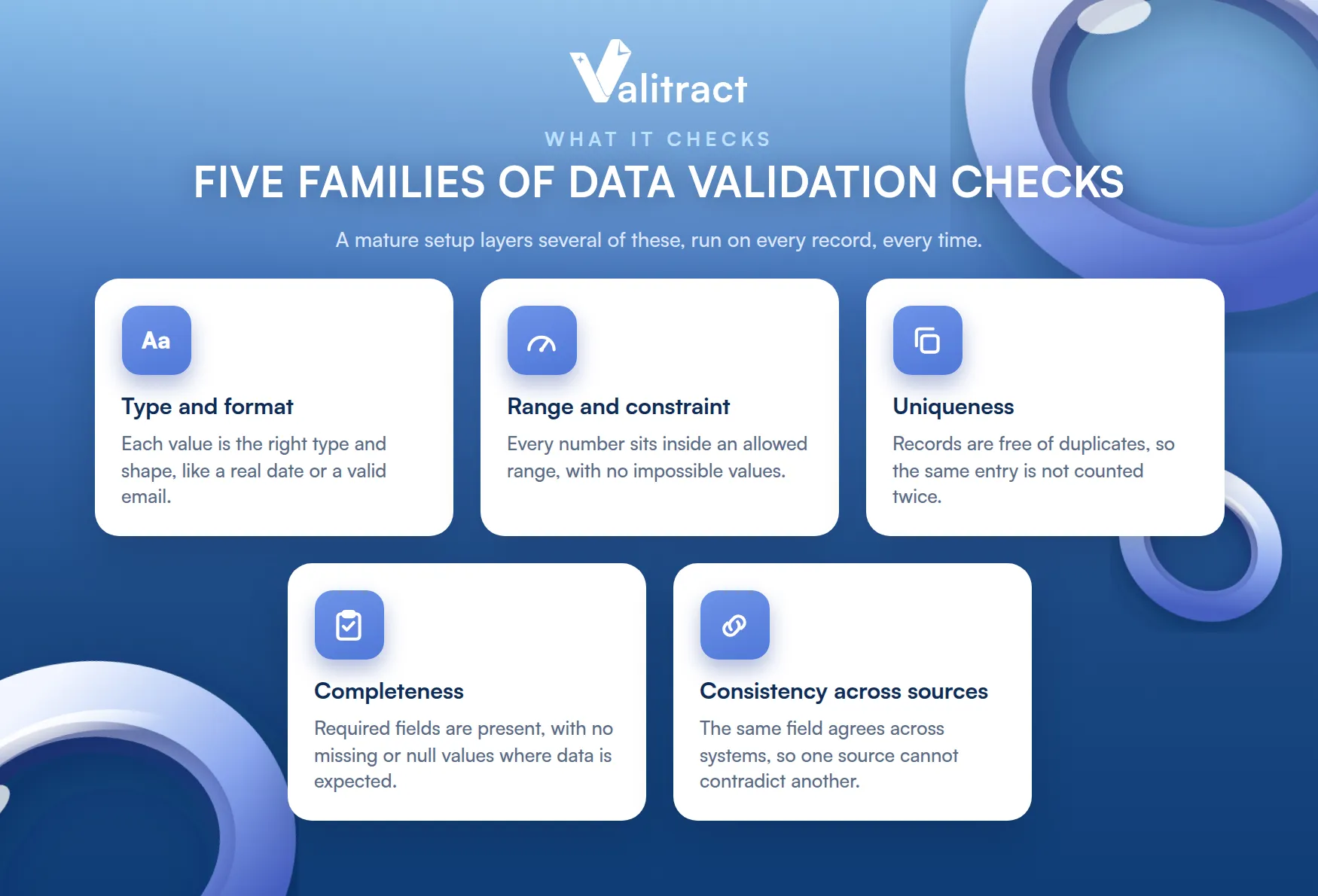
The checks fall into a few families: type and format, range and constraint, uniqueness, completeness, and consistency across sources. A mature setup layers several of them.
The right mix depends on the data. A finance feed leans on range and reconciliation checks, while a customer table leans on completeness and uniqueness.
The goal is simple to state and hard to do at scale. Every record that enters a system should be checked against a known standard before anything downstream depends on it.
The checks themselves are usually simple. The value comes from running them on every record, every time, without anyone having to remember.
Manual vs Automated Data Validation
Manual checks worked when data was small and slow. They break down the moment volume and velocity climb, which is the reality of every modern stack.
The break point is not a specific row count. It is the moment a person can no longer review each record and still keep up with the inflow.
The table below sums up the difference.
Table 1. Manual versus automated data validation.
| Parameter | Manual validation | Automated validation |
| Speed | Slow, limited to working hours | Real-time, continuous, 24/7 |
| Scalability | Caps out as volume grows | Scales with volume at near-flat cost |
| Human error risk | High, fatigue and typos | Low, rules apply consistently |
| Long-term cost | Rises with headcount | Predictable software fee |
Automation does not remove people from the loop. It moves them from checking every record to handling only the exceptions a rule flags, which is where human judgment actually helps. This is the same shift seen in moving from manual keying to automated data entry.
The payoff is focus. People spend their time on the handful of genuine edge cases instead of scanning thousands of clean rows.
Why Automated Data Flow Validation Is Crucial for Modern Enterprise Pipelines
A modern pipeline pulls from APIs, cloud warehouses, CRMs, and document inflows at the same time. Each source has its own quirks, and any one of them can inject bad data.
A field that is valid in one system can be malformed in the next. Validation is what reconciles those differences before they spread.
That is why automated data flow validation has to be continuous. A single check at the end cannot catch an error introduced three steps upstream.
Validation gates placed along the flow catch problems where they happen. The benefits compound across the business.
- It closes the garbage-in, garbage-out gap: Bad inputs never reach the model or the report, so the output stays trustworthy by default.
- It protects downstream dashboards and decisions: A broken feed gets caught before an executive acts on a chart built from corrupted numbers.
- It sustains compliance and security frameworks: Continuous checks support regulations like GDPR and HIPAA by keeping sensitive records accurate, complete, and auditable.
These are not separate wins. Faster, cleaner, and more compliant data all come from the same continuous checking.
The thread through all three is timing. Validation is most valuable the instant data arrives, not after it has already spread.
Think of it as a series of gates, not a final inspection. Each gate stops a smaller, cheaper problem than the one the next gate would face.
How to Automate Data Validation in 4 Steps
Automating validation is a repeatable process, not a one-off project. These four steps take you from rules to a live, self-monitoring system.
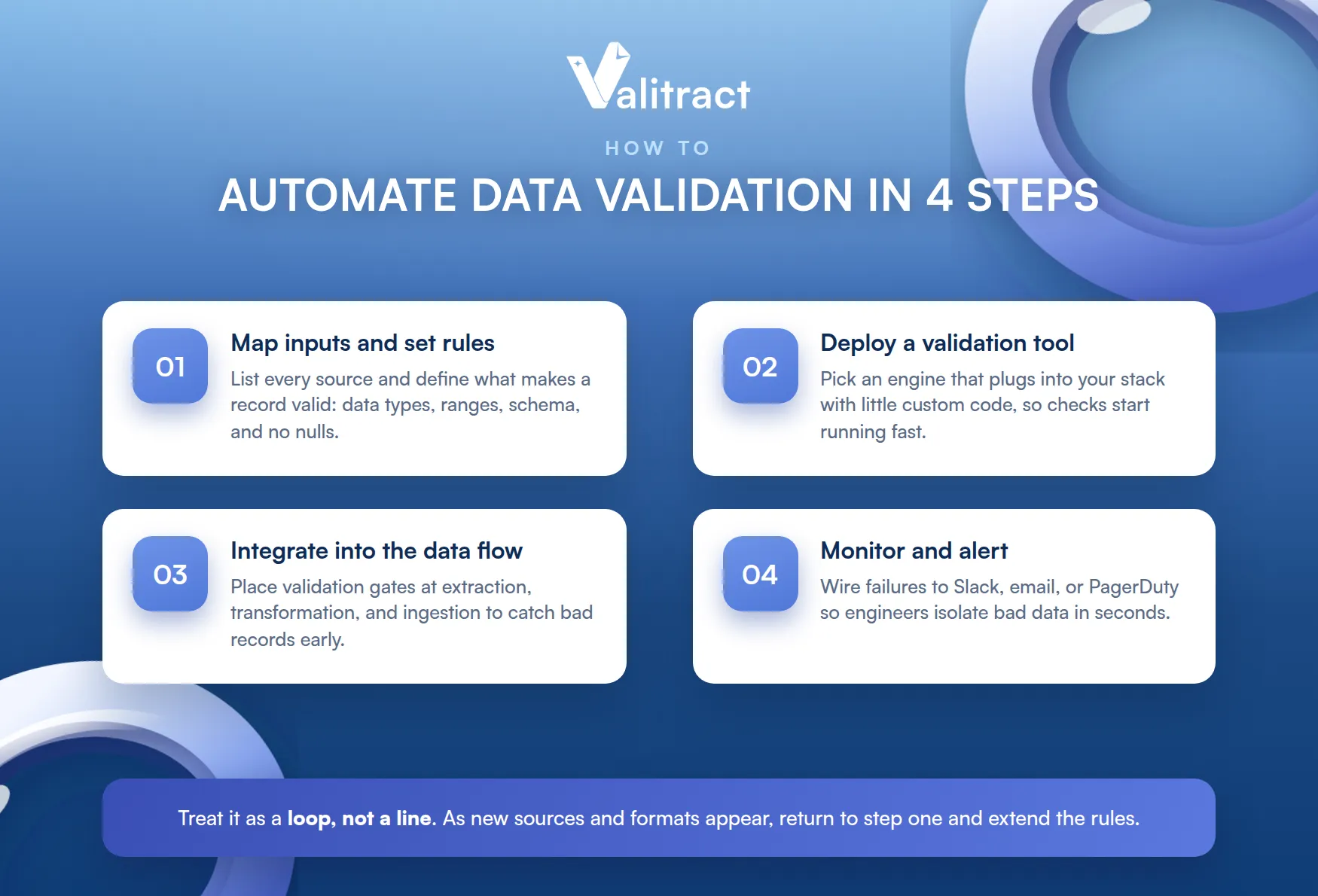
Treat it as a loop, not a line. As new sources and formats appear, you return to step one and extend the rules.
- Map out data inputs and establish rules: List every source and define the parameters that make a record valid, such as no null values, correct data types, schema adherence, and sensible value ranges. The rules are the contract every record has to meet.
- Deploy an automated data validation tool: Choose an engine that plugs into your existing stack without heavy custom code. The less engineering it takes to start, the sooner the checks are actually running.
- Integrate validation into the data flow and CI/CD pipeline: Place validation gates at the extraction, transformation, and ingestion phases. Catching a bad record at extraction is far cheaper than unwinding it after it lands in production.
- Set up continuous monitoring and automated alerting: Wire failures to Slack, email, or PagerDuty so engineers can isolate bad data immediately. An alert that fires in seconds turns a silent data outage into a quick, contained fix.
The order matters. Rules come first, the tool enforces them, the pipeline runs them everywhere, and monitoring keeps them honest over time.
None of the four steps is optional. Skip the rules and the tool has nothing to enforce, and skip monitoring, and the rules quietly rot as the data changes.
Top 5 Automated Data Validation Tools in 2026
The right tool depends on where your bad data comes from. Some problems start in a warehouse, and some start at the messy front door of documents and forms.
Buying the wrong category is a common mistake. A warehouse quality tool will not read a scanned invoice, and a document tool will not profile a billion-row table.
The five below cover both families. Match the tool to where your data actually breaks, not to brand recognition.
The table below orients the five before the detail.
Table 2. Quick comparison of top automated data validation tools in 2026.
| Tool | Set up | Best use cases | Pricing |
| Valitract | Fast, no-code plus API, template-free | Validating data extracted from documents at ingestion | Free tier, then usage-based |
| Datameer | SaaS on Snowflake, SQL and no-code | Data quality and transformation inside Snowflake | Subscription, by quote |
| Informatica | Enterprise, heavier setup | Large-scale integration, quality, governance, MDM | Enterprise quote |
| Talend (Qlik) | Cloud, on-prem, or hybrid, low-code | Enterprise data integration plus quality and governance | Tiered, enterprise quote |
| Alteryx | Desktop plus cloud, no-code | Analyst-led data prep, blending, and quality | Per-user subscription |
Source: vendor product pages and ownership announcements, accessed June 2026. Confirm current pricing and capabilities before committing.
1. Valitract (The Enterprise-Grade Choice For Document Data)
Valitract is a template-free AI platform that extracts and validates data from documents, then hands clean, structured data to the rest of your stack. It is the validation layer for the hardest input of all: unstructured invoices, statements, and forms.
See the Valitract AI data extraction platform for the full feature set.
Key features: layout-agnostic extraction, arithmetic and business-rule validation, confidence scoring, and human-in-the-loop review for low-confidence fields. Output is structured JSON through a REST API or a no-code dashboard, with support for 95+ languages.
Best for: teams whose data-quality problem begins with documents, where the win is turning a messy file into validated, system-ready data.
Pros: fast setup with no templates to maintain, accuracy of up to 99.8%, and configurable rules like matching an invoice total to its line items. Pairing it with dedicated invoice validation software adds a second layer of checks on financial documents.
Cons: Valitract validates document-sourced data, not arbitrary warehouse tables or streaming telemetry. For pipeline-wide or in-warehouse checks, run it alongside a data-quality platform rather than in place of one.
Think of it as the validated on-ramp for unstructured data. It cleans what enters the pipeline, and the rest of your stack takes over from there.
Pricing: a free tier to start, then usage-based as volume grows.
2. Datameer
Datameer is a SaaS data transformation and quality tool built specifically for Snowflake. It runs profiling and cleansing where the data already lives.
Best for: teams standardized on Snowflake that want data quality and transformation without moving data out.
Pros: a SQL and no-code canvas, profiling that surfaces anomalies, duplicates, and inconsistencies, plus continuous monitoring and alerts. It pushes processing down into Snowflake for performance.
Cons: it is tied to Snowflake, so it is not a fit for teams on other warehouses. It is also not a data integration tool on its own.
For a Snowflake-first shop, that focus is a feature, not a limit. It does one environment very well.
3. Informatica
Informatica is an enterprise cloud data management platform spanning integration, data quality, governance, and master data management. Salesforce completed its acquisition of Informatica in November 2025, folding it into the Salesforce data stack.
Best for: large enterprises that need governance and quality across many systems at scale.
Pros: deep, mature data-quality and governance tooling, broad connectivity, and AI-assisted features through its CLAIRE engine.
Cons: it is heavy to deploy and priced for the enterprise, which is overkill for a small team or a single workflow.
For most mid-sized teams, Informatica is more platform than the problem requires. Its strength shows at true enterprise scale.
4. Talend (Qlik)
Talend is now part of Qlik, delivered as Qlik Talend Cloud. It combines data integration, quality, and governance across cloud, on-premises, and hybrid setups.
Best for: enterprises that want integration and data quality in one platform, including a quality score across full datasets.
Pros: strong data profiling, a trust-score approach that checks entire datasets rather than samples, and low-code pipelines. It runs quality rules close to the data, including pushdown inside Snowflake.
Cons: the breadth adds complexity, and full value comes from adopting the wider Qlik Talend platform.
It is a strong fit if you already live in the Qlik ecosystem. As a standalone quality tool, lighter options exist.
5. Alteryx
Alteryx is an analytics automation platform built around no-code, drag-and-drop workflows. It blends data prep, validation, and analytics in one canvas.
Best for: analyst-led teams that want to clean, blend, and validate data without writing code.
Pros: an approachable visual builder, strong data-prep and blending tools, and a large library of pre-built steps.
Cons: per-user licensing adds up for large teams, and very high-volume pipeline validation is not its core strength.
Alteryx shines when the validator is an analyst, not an engineer. The visual canvas is its whole appeal.
Choosing the Right Automated Data Validation Tool
The best tool is the one that matches your data, your team, and your budget. Run through a short checklist before you commit.
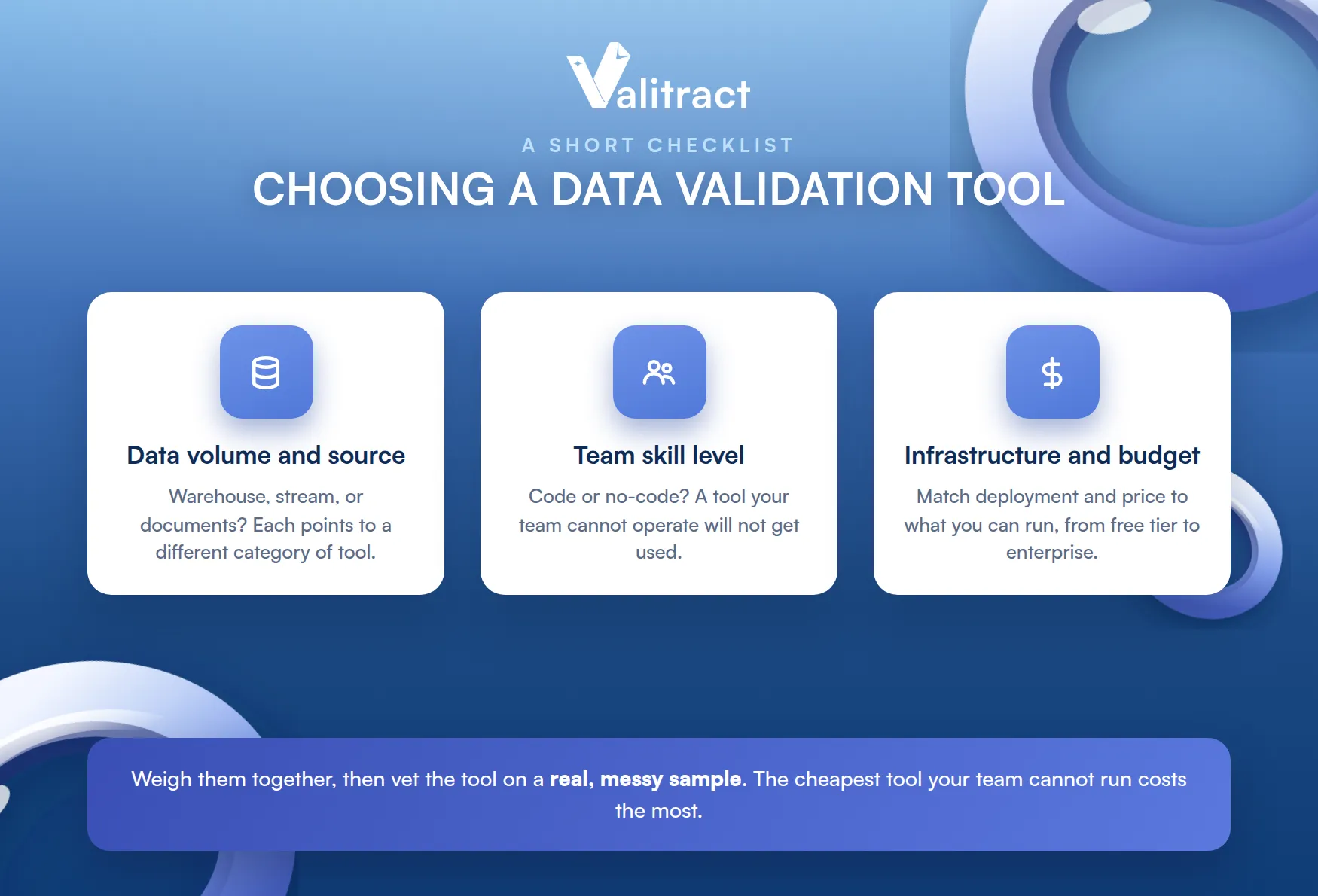
- Data volume and source: decide whether your bad data comes from a warehouse, a stream, or documents, since that points to a different category of tool.
- Team skill level: weigh code versus no-code, because a tool your team cannot operate will not get used.
- Infrastructure and budget: match the deployment model and price to what you can run and afford, from a free tier to an enterprise contract.
Weigh these together, not one at a time. The cheapest tool your team cannot run is more expensive than the right one.
For pipeline-wide quality in a warehouse, the enterprise platforms fit. When the validation problem starts with documents, Valitract is the sweet spot: fast to set up, no-code plus API, and built to scale from one workflow to enterprise volume.
If you are not sure where your data quality breaks first, start with the source that feeds the most decisions. You can always contact a vendor to test a real sample before buying.
Whatever you pick, vet the tool the way you will use it. Run it on a real, messy sample, not a clean demo file.
Applications of Automated Data Validation in Industries
The value of validation shows up differently in each sector. The data types and the rules change, but the principle holds: check it before you trust it.
1. Finance and Fintech
Finance runs on automated reconciliation, fraud detection, and transactional auditing. A wrong currency field, a duplicate transaction ID, or a corrupted ledger entry can trigger real compliance and financial risk.
Validation catches those errors before they post. Confirming that figures reconcile and that records are unique is the foundation of clean invoice validation and audit-ready books.
At scale, the risk is rarely one bad entry. It is a systematic error repeated across thousands of transactions before anyone notices.
Reconciliation is the daily heartbeat of finance. Automating it frees analysts to investigate the exceptions that actually matter.
2. Healthcare and Life Sciences
Healthcare depends on accurate electronic health records and rigorous computer systems validation. Regulators such as the FDA and EMA mandate data integrity for clinical trials, where an invalid input can put patient safety at risk.
The stakes raise the bar for validation. Every record has to be complete, consistent, and traceable, with an audit trail a regulator can follow.
Validation here is a safety control, not just a quality one. A flagged record can stop a bad input from reaching a clinical decision.
That is why the sector validates so rigorously. The cost of a wrong record is measured in patients, not dollars.
3. Smart Manufacturing and IoT
Smart factories ingest high-frequency telemetry from thousands of sensors. Automated checks filter out noise, impossible spikes, and broken data packets before they reach the model.
Bad sensor data skews predictive maintenance and quality control. Validation at ingestion keeps a single faulty sensor from corrupting a whole forecast.
The volume makes manual review impossible. Only automated rules can keep pace with thousands of readings a second.
4. Omnichannel E-commerce and Retail
Retailers sync inventory and pricing across storefronts and warehouses constantly. A validation failure shows up as overselling a sold-out item or mispricing a product.
Checking supply-chain and pricing inputs keeps the catalog honest. Accurate stock and price data is the difference between a sale and a refund.
Speed matters as much as accuracy here. A stale inventory count is wrong within minutes during a busy sale.
Frequently Asked Questions About Automated Data Validation
What is a real-world example of automated data validation?
A common example is an accounts payable system that checks every imported invoice for a valid date, a non-null vendor, and a total that matches the sum of its line items. Any invoice that fails is flagged or rejected before it posts to the ERP, so a bad record never reaches the ledger.
Are there free data validation tools available on the market?
Yes. Open-source frameworks like Great Expectations and Soda Core are free to use, and several commercial tools, including Valitract, offer a free tier. The trade-off is that free open-source options usually need more engineering effort to set up and maintain.
How does automated data flow validation differ from standard database testing?
Database testing checks a system at a point in time, confirming that a schema, query, or migration works as designed. Automated data flow validation runs continuously on live data moving through the pipeline, catching bad records as they arrive rather than verifying the system once.
Concluding Thought
Automated data validation has shifted from a nice-to-have to core infrastructure. The volume is too high and the cost of a bad record too real to leave it to manual review.
The practical move is to match the tool to the source. Use a warehouse-native platform for pipeline quality, and a document-native tool like Valitract where messy files are the weak point.
Few teams need only one. The realistic end state is a layered setup where each tool guards the source it handles best.
The destination is the same either way. It is data you can act on without checking it twice.
Start with the one source that feeds the most decisions, prove the savings there, and expand from a position of evidence. To validate document data at the point of capture, explore the Valitract AI data extraction platform.
Valitract – Next-gen AI-Powered Data Extraction Platform
- Email: contact@valitract.com
- LinkedIn: https://www.linkedin.com/company/valitract-api-platform
- X: https://x.com/valitract