


- Nanonets is a strong, intelligent document processing platform, but teams outgrow it on post-extraction validation, retraining effort, and usage-based cost at scale.
- The best Nanonets alternative depends on whether you need raw extraction, a no-code workflow, or validation built into the capture step.
- This guide compares five alternatives: Valitract, Docsumo, Amazon Textract, Google Document AI, and Rossum.
- Valitract is the strongest fit when you want template-free extraction with built-in validation and transparent pricing.
Nanonets is a popular intelligent document processing platform, and for good reason. It reads invoices, receipts, and forms well, with a no-code workflow builder that non-developers can pick up quickly.
That ease is real, and it is why so many teams start there. The questions come later, when volume and document variety climb.
The friction shows up at scale. As pipelines grow, teams hit limits with post-extraction validation, the effort of retraining on messy legacy layouts, and a usage-based price that is hard to predict.
That is when the search for a Nanonets alternative begins. The goal is not just to read a document, but to trust the data that comes out of it.
Reading is now close to a solved problem. The harder, more valuable job is making sure the data is right.
This guide reviews the top alternatives for 2026, free and paid, so you can find the best fit for your stack.
Each section keeps the same shape: what the tool does, who it suits, and where it falls short. Skim to the one that matches your problem.
The Top 5 Nanonets Alternatives for 2026
Each tool below solves a slightly different problem. Some are raw extraction APIs, some are full no-code platforms, and some put validation at the center.
Knowing which type you need narrows the field fast. A developer wants an API, while an operations lead wants a finished workflow.
We include Nanonets in the table as the baseline. The five alternatives are ranked by how cleanly they solve a problem Nanonets leaves open.
None of them is a Nanonets clone. Each makes a different trade between control, ease, and price.
The table gives a quick orientation before the detail.
Table 1. Nanonets versus the top five alternatives in 2026.
| Tool | Best for | Free tier | Pricing | Standout feature | Import and export | Data validation |
| Nanonets | No-code AP and invoice workflows | Yes, $200 credits | Usage-based per run | No-code workflow builder | Email, API, scan, many connectors | Workflow rules, limited DB checks |
| Valitract | Template-free extraction with validation | Yes, free tier | Usage-based, transparent | Validation built into capture | API and no-code, JSON export | Built-in arithmetic and rule checks |
| Docsumo | Financial document processing | Free trial | Subscription, custom | Depth on financial docs | API and integrations | Configurable validation rules |
| Amazon Textract | Developers needing a raw OCR API | AWS free tier, 3 months | Pay per use | Scalable AWS OCR | API and S3, JSON | None native |
| Google Document AI | Developers building on GCP | Limited free tier | Pay per use | Specialized processors | API, JSON | Limited, processor dependent |
| Rossum | Enterprise invoice processing | Trial | Enterprise, custom | Cognitive invoice engine | API and integrations | Strong validation interface |
Source: vendor pricing and documentation pages, accessed June 2026. Confirm current pricing before committing.
1. Valitract
Valitract is a template-free platform that extracts and validates document data in one step.
Where most tools stop at reading the page, Valitract checks the data before it leaves the capture layer. Explore the Valitract AI Data Extraction Platform for the full feature set.
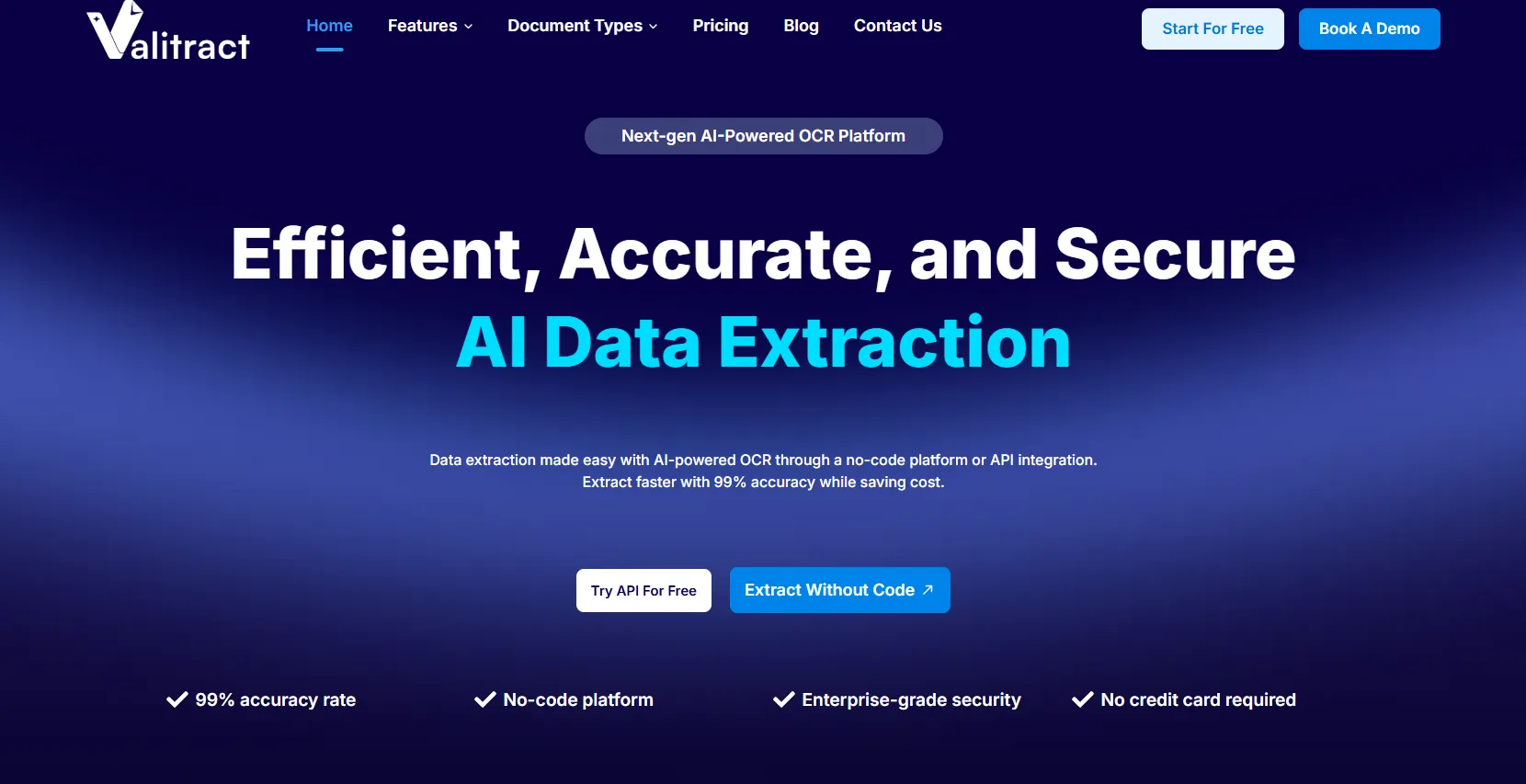
Features: Layout-agnostic extraction, arithmetic and business-rule validation, confidence scoring, and human-in-the-loop review. Output is clean JSON through a REST API or a no-code dashboard, with support for 95+ languages. The platform also flags low-confidence fields automatically, so nothing borderline slips through unseen.
Best for: Teams that want validated, structured data out of varied documents without maintaining templates.
The practical effect is fewer surprises downstream. A reviewer sees only the documents that actually need a human, and the rest flow through clean.
Pros: Validation is built in, not bolted on, so a total that does not match its line items is caught at capture. Accuracy reaches up to 99.8%, setup is fast, and pricing is transparent with a free tier. Predictable cost matters as much as the headline rate, since you can model spend before you scale rather than discover it after.
Cons: Valitract is focused on document data, so it is not a general pipeline or warehouse validation tool. It currently lists GDPR alignment with SOC 2 and ISO 27001 in progress, so confirm certification status if you have strict regulatory needs.
For teams whose pain is dirty data rather than raw reading speed, that focus is the point. It solves the problem they actually have.
Because there are no templates, a new document type works on the first upload. There is nothing to retrain.
Pricing: A free tier to start, then usage-based pricing.
2. Docsumo
Docsumo is an intelligent document processing platform with real depth in financial documents. It handles bank statements, invoices, and tax forms through a consistent extraction and validation interface.
Features: Transaction extraction, balance and rule validation, a review interface for exceptions, and webhook integrations. Its review screen is built for finance reviewers, with the validation context sitting right next to the extracted figure.
Best for: Finance and lending teams that mostly process financial document types. For that audience, the financial focus is a strength rather than a limitation.
Pros: Strong on financial documents, configurable validation rules, and a clear review workflow.
Cons: Workflow features are lighter than the largest enterprise platforms, and pricing is subscription-based by quote.
Docsumo is a natural step up for a team drowning in financial PDFs. It is less of a fit if your documents span many unrelated types.
Outside finance, a more general platform usually serves better. Inside it, Docsumo is hard to beat.
3. Amazon Textract
Amazon Textract is a pay-per-use OCR API from AWS. It extracts text, forms, and tables at scale, and it is built for developers rather than business users.
Features: Document text detection, forms and tables extraction, and queries, all through the AWS API. Output is structured JSON keyed to the page, ready for whatever logic you layer on top.
Best for: Engineering teams that want raw extraction inside an existing AWS stack. If you already run on AWS, the integration is close to free in effort terms.
Pros: Highly scalable, predictable per-page API pricing, and deep AWS integration. A free tier covers the first three months.
Cons: It is a raw API with no UI and no business-rule validation, so you build the workflow and the checks yourself.
Think of Textract as a building block, not a finished product. It gives you accurate text, and your team builds everything that turns that text into a decision.
4. Google Document AI
Google Document AI is Google Cloud’s document processing service. It offers general OCR plus specialized processors for common document types.
Features: OCR, form parsing, and prebuilt and custom processors, all on Google Cloud. The specialized processors cut setup time for common types like invoices and receipts.
Best for: Teams already on GCP that want extraction close to their other cloud services. Proximity to BigQuery and the rest of GCP is the real draw here.
Pros: Strong OCR, a range of specialized processors, and pay-per-use pricing that scales.
Cons: Validation is limited and processor-dependent, and you need cloud engineering skills to get the most from it.
It rewards teams that already speak Google Cloud. Outside that ecosystem, the setup cost is harder to justify.
5. Rossum
Rossum is an enterprise platform focused on transactional documents, especially invoices. It pairs a learning extraction engine with a strong validation interface.
Features: Cognitive invoice capture, a built-in validation screen, and enterprise integrations. The validation screen is where Rossum shines, surfacing every field that needs a human glance in one view.
Best for: Large enterprises automating high-volume accounts payable. At that scale, its validation interface pays for itself in reviewer time.
Pros: A polished validation interface and a model that improves with corrections.
Cons: It is priced for the enterprise and is heavier than smaller teams need.
Rossum earns its price in high-volume AP shops. For a few hundred documents a month, lighter tools deliver most of the value.
Why Businesses Are Switching from Nanonets
Nanonets works well for common documents at moderate volume. The push to switch usually comes down to three recurring frustrations seen across review platforms.
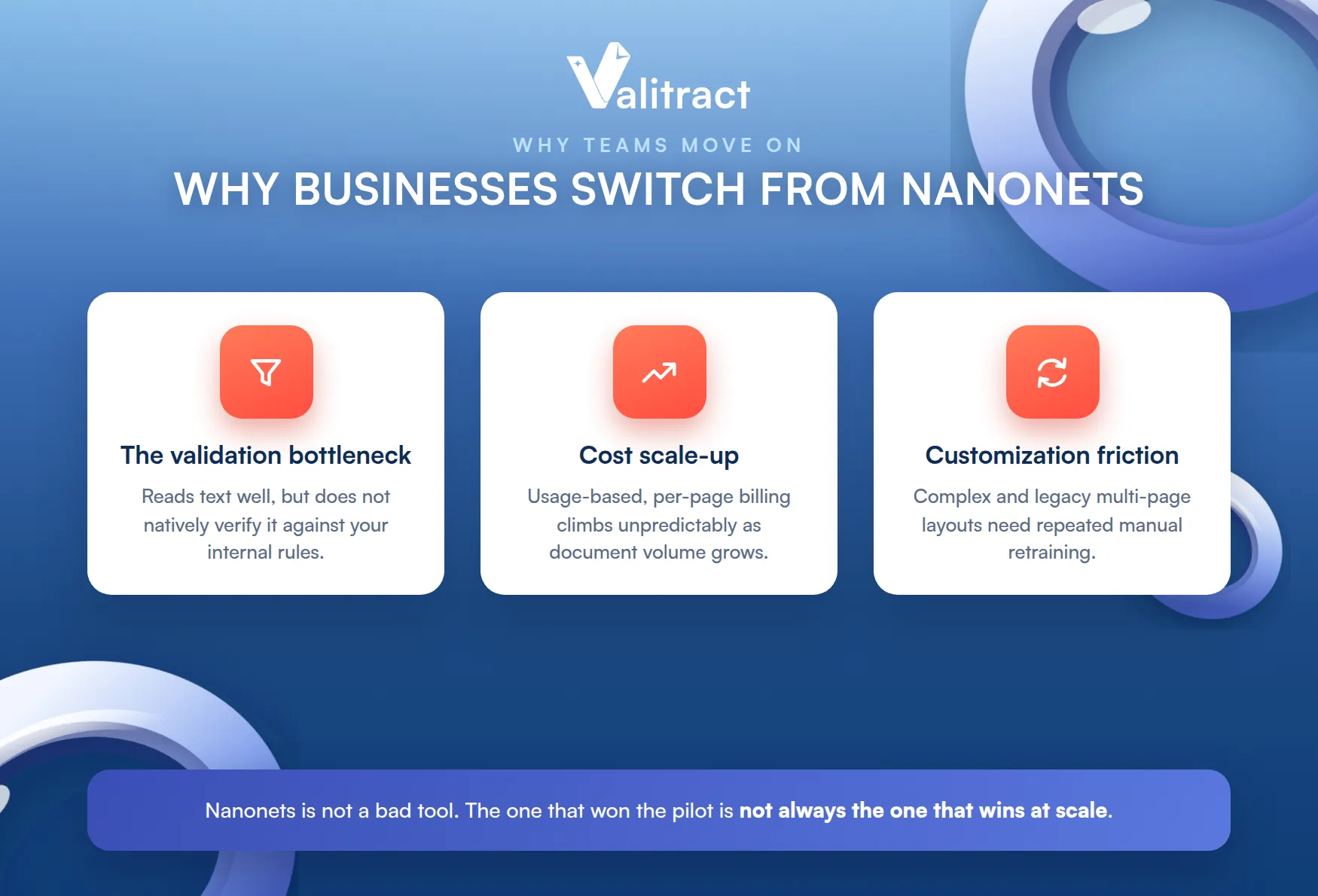
These are not edge complaints. They show up again and again once a deployment moves past pilot scale.
- The validation bottleneck: Nanonets reads text well, but it does not natively verify that the text matches your internal database rules. That is the gap between reading data and trusting it.
- Cost scale-up: High-volume, multi-page flows get expensive under usage-based billing. A long document counts every page, so cost climbs unpredictably as volume grows.
- Customization friction: Highly unstructured or legacy multi-page layouts can require repeated manual retraining. That upkeep adds hidden effort the original setup did not reveal.
None of these mean Nanonets is a bad tool. They mean a team’s needs have outgrown what it does best, which is exactly when an alternative earns its place.
The trigger is almost always growth. A tool that felt cheap at a thousand documents a month feels different at fifty thousand.
The pattern is consistent across reviews. The tool that won the pilot is not always the tool that wins at scale.
Key Considerations When Choosing a Nanonets Alternative
Auditing alternatives is easier with a short framework. Three questions separate the right fit from the wrong one.
Answer them honestly before you book a single demo. The wrong category wastes weeks no matter how good the tool is.
Categories matter more than brands here. A great tool in the wrong category still loses to an average one in the right category.
Extraction Accuracy vs Data Integrity
First, decide what you actually need. Reading text accurately is one job, and ensuring the resulting data is clean and consistent is another.
If a wrong number can break a downstream report or payment, you need validation, not just extraction. A good AI data extraction tool reads the page, while a stronger one also checks the result before passing it on.
The distinction sounds academic until a bad record posts to your ledger. Then it is the only thing that matters.
Be honest about which side of the line you sit on. Most teams that think they only need extraction actually need validation too.
Budgeting for Free vs Paid
Many teams start by searching for a free Nanonets alternative, which is a reasonable first step. Open-source OCR and limited free tiers exist, and they are good for testing.
Production is a different bar. Enterprise workflows need uptime guarantees, support, and data governance that free open-source tools rarely provide without significant engineering.
Free is a starting line, not a finish line. Budget for the version you will actually run in production.
A free tier is the cheapest way to test fit. Just do not mistake a successful test for a production-ready deployment.
Integration Architecture
Finally, check how the tool fits your stack. A clean extraction is only useful if its output drops into your warehouse, such as Snowflake or BigQuery, or your CI/CD pipeline without custom glue.
Look for standardized JSON output and a documented API. A tool with a developer-friendly OCR API is far easier to wire into existing systems than one that locks data behind a closed UI.
The integration cost is easy to underestimate. A tool that needs custom glue for every system quietly becomes its own maintenance project.
Ask for a sample JSON payload during evaluation. It tells you more about real integration effort than any feature list.
The Best Alternative to Nanonets: Valitract
For most teams weighing a switch, Valitract is the logical upgrade. It keeps the template-free convenience that makes Nanonets easy, then adds the validation layer that teams reach an alternative to find.
It is less a different category than a sharper version of the same one. You keep the convenience and add the certainty.
Comparing Valitract vs Nanonets
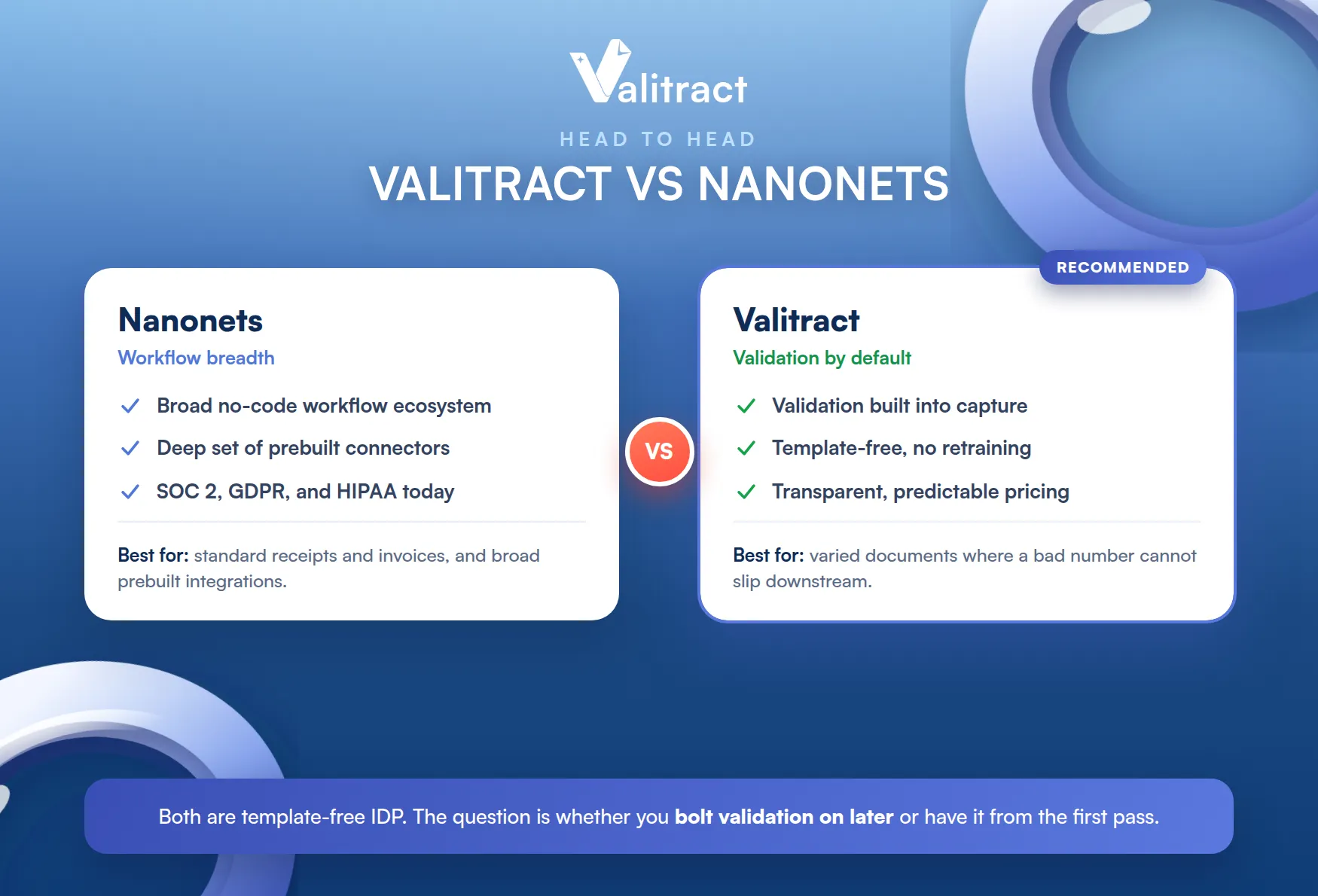
Both tools are template-free document IDP platforms, so the comparison is not extraction versus no extraction. The difference is where each one puts its emphasis.
Nanonets leads with a broad no-code workflow ecosystem and a deep set of prebuilt connectors. It is also further along on compliance, currently listing SOC 2, GDPR, and HIPAA.
If HIPAA is a hard requirement today, that is a genuine point in Nanonets’s favor. Weigh it honestly against the validation gap.
For everyone without that hard requirement, the validation built into capture is the bigger day-to-day win.
Valitract leads with validation built into the capture step and pricing that is simple to predict. The result is clean, checked data by default, rather than reading first and validating later.
Neither approach is wrong on its own. The question is whether you would rather bolt validation on later or have it from the first pass.
What Makes Valitract Different
Valitract treats validation as part of extraction, not a separate project. Its AI Data Parsing Software reads a document and checks the result against your rules in the same pass.
Three core capabilities stand out in this workflow:
- Low-code rule engine: Let’s teams easily set and customize their own data checks.
- Arithmetic validation: Automatically catches figures and line items that do not reconcile.
- Confidence scoring: Routes only uncertain or low-score fields to a human reviewer.
Together, those three features turn extraction into a checkpoint, not just a reader. The data that leaves has already been tested.
The aim is simple: clean, structured data leaves the platform, and questionable data stops for review. That keeps dirty records from quietly reaching your analytics or your ledger.
That single shift changes the economics of review. Instead of checking everything, your team checks only what the system is unsure about.
To be clear about the scope, Valitract validates the data it extracts from documents. For validation across an entire warehouse or streaming pipeline, it complements a data-quality platform rather than replacing one.
When to Use Each Tool
Both tools are good; the right pick depends on the job.
- Choose Nanonets when its mature workflow ecosystem, broad connectors, and HIPAA coverage match your needs, especially for standard receipts and invoices.
- Choose Valitract when you want template-free extraction with validation built in, transparent pricing, and clean JSON your systems can trust. It fits teams that handle varied documents and cannot afford a bad number slipping downstream.
If you are still unsure, run both on the same stack of real documents. The right tool usually becomes obvious within a day.
Whichever you choose, validate on your real documents, not a vendor’s clean demo. Your edge cases are where tools separate.
Frequently Asked Questions About Nanonets Alternatives
What is the best open-source alternative to Nanonets?
For pure OCR, open-source options like Tesseract, docTR, and PaddleOCR are the most common starting points. They are free and flexible, but they only read text; you build the extraction logic, validation, workflow, and support around them yourself, which takes real engineering time.
Are there any free alternatives to Nanonets?
Yes. Several tools offer a free tier or trial, including Valitract’s free tier, the AWS and Google Cloud free tiers, and open-source OCR libraries. Free options are ideal for testing, but production workflows usually need the uptime, support, and governance that paid plans provide.
How does Valitract compare to Nanonets?
Both are template-free document processing platforms, so both read varied documents without per-template setup. Valitract emphasizes validation built into the capture step and transparent pricing, while Nanonets offers a broader no-code workflow ecosystem and more compliance certifications today, including HIPAA. The right choice depends on whether you prioritize validation and pricing clarity or workflow breadth.
Concluding Thought
There is no single best Nanonets alternative, only the best fit for your documents, your team, and your budget. Raw APIs like Textract and Google Document AI suit developers, while platforms like Docsumo, Rossum, and Valitract suit teams that want extraction and validation together.
The deciding question is whether you need to read documents or trust them. If a wrong field carries real cost, choose the tool that validates at capture rather than hoping a later check catches it.
The cost of a wrong field rarely shows on the tool’s invoice. It surfaces later, in a refund, a mispayment, or a report nobody trusts.
Treat the choice as reversible. Start narrow, measure the result, and switch if the numbers do not hold up.
Document processing is no longer about whether software can read a page. It is about whether you can trust what it read.
Start with the workflow that hurts most, test each option on your own messy documents, and expand from there. To see template-free extraction with built-in validation on your files, explore the Valitract AI Data Extraction Platform.
Valitract – Next-gen AI-Powered Data Extraction Platform
- Email: contact@valitract.com
- LinkedIn: https://www.linkedin.com/company/valitract-api-platform
- X: https://x.com/valitract