


- Human-in-the-loop (HITL) document processing is a workflow design where AI handles bulk extraction from documents such as invoices, bank statements, and contracts, and routes low-confidence or rule-triggered fields to a human reviewer for validation.
- These human corrections can feed back into the AI, improving accuracy over time while ensuring data integrity in production pipelines.
Human-in-the-loop (HITL) document processing exists because no AI reads every document perfectly. The design accepts that reality and builds around it, letting AI do the bulk work while a person checks the small share that is genuinely uncertain.
The honest version of automation includes this admission. Any vendor claiming a tool never needs a human is selling the demo, not the production reality.
The result is the best of both: the speed and scale of automation, with the accuracy and accountability of human judgment where it matters. This guide explains how HITL works, the metrics that define a working system, who needs it, and where automation genuinely helps versus where a human still has to stay in the loop.
The design has one non-negotiable prerequisite. It only works when the AI can tell you how confident it is, field by field, so the right cases reach a person and the rest do not.
How HITL Document Processing Actually Works
HITL runs as a five-step loop, and the loop is the point. Each pass through it should need less human effort than the last.
That closing of the loop is what separates HITL from ordinary review. A system that reviews the same volume forever is not learning; a HITL system should need a human less over time.
Ingest and extract. The AI receives the document (a PDF, scan, or photo), identifies its layout, and extracts the fields into structured data such as JSON or CSV. This is the foundation, and its quality shapes everything that follows.
Confidence scoring. The AI assigns a field-level confidence score to each extracted value, distinguishing high-certainty printed text from an ambiguous handwritten entry. Scoring per field, not per document, is what makes precise routing possible.
Route by rules. Configurable business rules flag fields that fall below a confidence threshold, are missing entirely, or come from a high-risk document source, sending only those for manual inspection. Everything else passes straight through.
Human review. A reviewer confirms or corrects the flagged data through an interface that, ideally, highlights the specific fields in question rather than the whole document. The narrower the reviewer’s focus, the faster and more accurate the review.
Feedback loop. Corrections are logged and can be used to retrain or fine-tune the model, reducing how much human intervention future batches need. Over time, a working loop shrinks its own review queue.
Why HITL Exists, and What Breaks Without It
Even the best AI models make errors under certain document conditions, and in regulated industries those errors carry real financial and operational risk. HITL is the control that catches them before they reach production.
The alternative is unappealing on both ends. Fully manual entry does not scale, and fully unchecked automation ships errors at machine speed,so HITL is the middle path that keeps both problems in check.
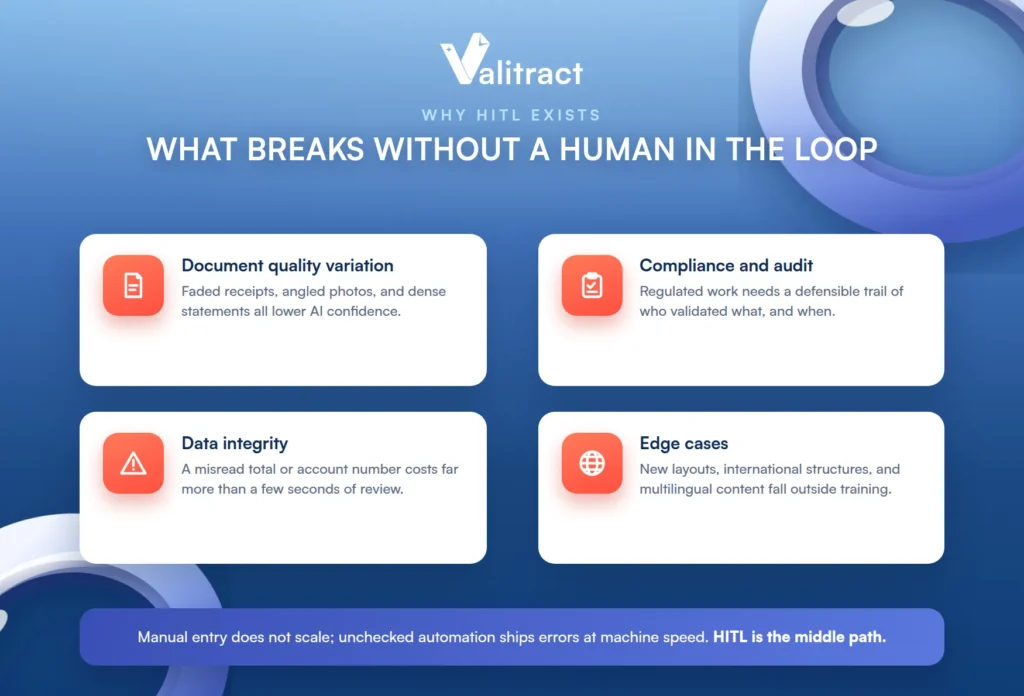
Document quality variation. Faded receipts, angled phone photos, and dense bank statements all lower AI confidence, which is exactly where human oversight earns its place. A tool that is confident on clean documents can still stumble on the messy ones you actually process.
Compliance and audit. Regulated sectors need a defensible trail showing who validated which data and when, and HITL produces that record naturally. The review step is also an audit artifact.
Data integrity. A misread invoice total or account number creates downstream costs (failed payments, broken reconciliations, disputes) that dwarf the cost of a few seconds of human review. Preventing the error is far cheaper than chasing it later, a theme we cover in our guide to reducing data entry errors.
Edge cases. New layouts, international document structures, and multilingual content often fall outside a model’s training, and those are precisely the cases a human should see. HITL is how a system handles the unfamiliar without failing silently.
The Metrics That Define a Working HITL System
You cannot manage a HITL workflow you do not measure. These five metrics tell you whether it is working and where it is stuck.
Each one answers a different question. Together they tell you how much the AI handles, how good it is, how fast the humans are, and what to fix next.
| Metric | What it measures and why it matters |
|---|---|
| STP rate | Straight-through processing percentage; how much the AI handles autonomously, and how well it is scaling |
| Pre-review accuracy | The AI’s baseline performance before any human correction |
| Post-review accuracy | Final accuracy after review, which must meet your business SLA (for example, 99.5%) |
| Average review time | Time spent per document, which surfaces workflow and interface bottlenecks |
| Override rate | How often reviewers correct a given field, which points directly at what needs retraining |
Read together, these metrics tell a story. A high STP rate with high post-review accuracy is a healthy system; a low STP rate or a rising override rate on one field is a signal to act.

The override rate is the most actionable of the five. A field that reviewers keep correcting is a precise, ready-made target for the next round of model improvement.
Who Actually Needs HITL, and How the Use Case Changes by Audience
HITL serves very different teams, and the emphasis shifts with each. What one treats as the whole point, another barely uses.
What they share is a low tolerance for silent errors. In each case, a wrong value that slips through unreviewed is more expensive than the review would have been.
AP and finance operations prioritize speed and STP rate, because a bottleneck here means late payments, disputes, and reconciliation failures. Their goal is to review as little as possible while keeping totals correct.
Lending and underwriting teams validate the critical figures where a single wrong digit changes a credit decision. For them, targeted review of high-stakes fields matters more than raw throughput.
Insurance claims teams manage high volumes of wildly varying quality, from clean digital forms to blurry mobile photos. HITL is how they keep accuracy steady across that range.
Healthcare teams validate patient and medication data, where an error is a safety and compliance risk, not just a cost. The review step here is about protection as much as accuracy, and regulated deployments must be checked against each vendor’s specific compliance posture.
Forensic reviewers use AI pre-extraction to streamline a workload that will still get intense manual scrutiny. HITL does not replace their analysis; it clears the low-value work so they can focus on it.
Where Automation Actually Helps, and Where It Doesn’t
Extraction is the foundation of every HITL workflow. If the extraction is poor, reviewers waste their time fixing basic misreads instead of applying judgment to genuinely ambiguous data, which defeats the purpose of the design.
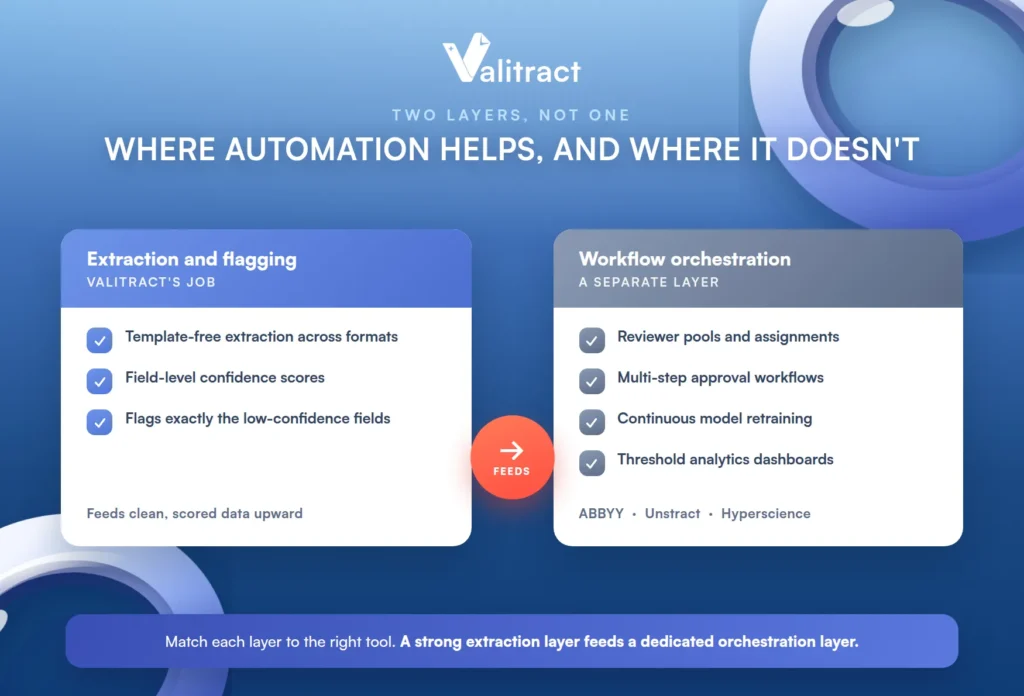
This is the step Valitract is built for. It provides template-free extraction across formats, generates field-level confidence scores, and highlights specific low-confidence fields for review, so the human sees only what actually needs a human. These extraction and flagging capabilities are the core of HITL, and getting them right is what makes the rest of the workflow efficient. Our guides to automated data validation and AI data extraction tools cover this layer in depth.
The quality of the flagging is as important as the quality of the read. Flag too much and you drown reviewers; flag too little and errors slip through, so the value is in flagging exactly the right fields.
The honest boundary is the orchestration layer above extraction. Managing reviewer pools, multi-step approvals, continuous model retraining, and threshold analytics is a distinct job, and platforms like ABBYY, Unstract, and Hyperscience are built for it. Valitract provides the accurate extraction and confidence flagging that feed those workflows; it is not a full workflow-orchestration and retraining platform itself, and a complete HITL stack often pairs a strong extraction layer with a dedicated orchestration layer.
Being clear about that split helps you buy well. You match each layer to the right tool instead of expecting one product to do the whole job and being disappointed by the half it does poorly.
When HITL Becomes a Bottleneck, and How to Prevent It
HITL is a control, but a poorly run loop becomes the very slowdown it was meant to prevent. Five failure modes account for most of the trouble.
Most of them are process failures, not tool failures. A capable extraction engine still bottlenecks if the review workflow around it is badly designed.
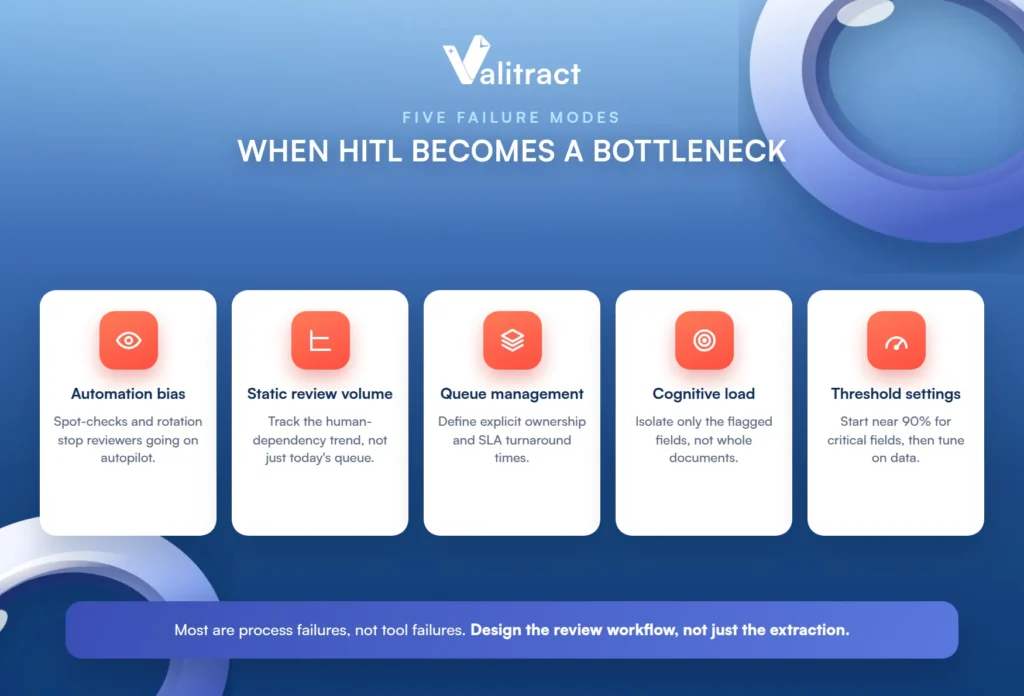
Automation bias. Reviewers start rubber-stamping AI output instead of checking it. Counter it with periodic spot-checks and by rotating review assignments so no one goes on autopilot.
This one is subtle because the metrics can look fine. A reviewer who approves everything still clears the queue, so you have to watch quality, not just speed.
Static review volume. If the feedback loop is broken, the queue never shrinks, and HITL stops being temporary scaffolding and becomes permanent manual labor. Track the human-dependency trend as a core KPI, not just today’s queue size.
Queue management. Unowned queues pile up. Define explicit ownership and SLA turnaround expectations so nothing sits unreviewed for days.
Cognitive load. Asking reviewers to scan whole documents is slow and error-prone. A targeted interface that isolates only the flagged fields is dramatically faster and more accurate.
Threshold settings. Set thresholds too low and you review almost everything, which is just manual entry with extra steps. A reasonable starting point is around 90% for critical fields, then adjust up or down based on your actual performance data.
How to Evaluate HITL Capabilities When Choosing a Platform
When comparing document automation tools, the HITL features are easy to overlook and expensive to lack. Four capabilities separate a real HITL platform from one that merely claims it.
Many tools market HITL without really supporting it. The details below are how you tell a genuine capability from a checkbox on a feature page.
Field-level confidence scoring. Look for granular scores on each field, not a single score for the whole document, because only field-level scoring lets you route precisely. Without it, HITL degrades into reviewing whole documents by hand.
Configurable rules. You should be able to adjust thresholds by document type and business criticality, so a bank account number and a memo field are not held to the same bar.
UI efficiency. Side-by-side source-and-data views, keyboard shortcuts, and targeted field display are what make review fast at volume rather than a slog.
Audit trail. Comprehensive logging of who reviewed what data and when is non-negotiable for regulated workflows, and it is far easier to have from day one than to add later.
Common Mistakes in HITL Document Processing
Beyond the operational bottlenecks above, a few design and selection mistakes undermine HITL projects before they start. Each is easy to avoid once named.
They tend to surface late, after a tool is already in production. Catching them at the evaluation stage is far cheaper than reworking a live pipeline.
The first is judging a tool on extraction accuracy alone, ignoring the routing, review interface, and audit trail that make HITL actually work in production. A perfect reader with a poor review workflow still creates a slow, painful process.
The second is accepting a single document-level confidence score when you need field-level scoring. Without per-field confidence, you cannot route just the uncertain values, so you end up reviewing whole documents or trusting them blindly.
The third is assuming one platform does both extraction and full orchestration. These are two layers, and expecting a strong extraction tool to also manage reviewer pools and retraining, or vice versa, leads to a tool that does neither part well. Our guides to intelligent document processing software and document workflow software map these layers out.
The fourth is applying one confidence threshold to every field regardless of its risk. Critical fields deserve a higher bar and more review; low-risk fields do not, and treating them the same either wastes review time or lets important errors through.
The fifth is launching without an audit trail and discovering the gap only when a compliance review asks who validated a given value. In regulated workflows, the log is part of the product, not an afterthought.
Frequently Asked Questions About HITL Document Processing
What is human-in-the-loop document processing?
It is a workflow where AI extracts data from documents in bulk and routes only the low-confidence or rule-flagged fields to a human for validation. The human corrects the uncertain cases and can feed those corrections back to improve the model, combining automation’s speed with human accuracy.
What is the difference between HITL and manual data entry?
In manual data entry, a person keys every field. In HITL, AI handles the bulk of the extraction and a person reviews only the small fraction flagged as uncertain, so the human effort scales with the exceptions rather than the total volume.
When is HITL necessary versus optional in document workflows?
It is necessary wherever errors carry real cost or compliance risk, such as finance, lending, insurance, and healthcare, and wherever document quality varies widely. It is more optional for low-stakes, high-quality, high-volume documents where an occasional error is cheap to absorb.
What confidence threshold should I set for human review?
A common starting point is around 90% for critical fields, then adjusting based on your measured accuracy and review capacity. The right number depends on the cost of an error versus the cost of review, so critical fields warrant a higher threshold than low-risk ones.
Can HITL work with any document type, or only invoices?
It works with any document type, including bank statements, contracts, IDs, claims forms, and medical records. The design is format-agnostic; what changes by document type is which fields you flag and how strict the thresholds are.
Does HITL slow down document processing?
Not when it is designed well. Only flagged fields go to review while the rest pass straight through, so a high straight-through-processing rate keeps most documents fully automated, and a targeted review interface keeps the exceptions fast.
How does HITL improve AI accuracy over time?
Human corrections are logged and can be used to retrain or fine-tune the model, so the cases that needed review this month are more likely to pass automatically next month. A working feedback loop steadily shrinks the share of documents that need a human.
Is HITL the same as intelligent document processing (IDP)?
No. HITL is a design principle (keeping a human in the loop for uncertain data), while IDP is the broader category of end-to-end document automation. HITL is a component of a well-built IDP system, not a synonym for it.
Conclusion
Human-in-the-loop document processing works because it puts automation and human judgment where each is strongest: AI on the bulk, people on the genuinely uncertain. The design lives or dies on two things, accurate extraction and precise field-level flagging, because everything downstream depends on the human seeing only what truly needs a human.
Understood as layered, HITL stops being intimidating. You get the extraction and flagging right first, then add the orchestration your volume and compliance needs actually require.
Valitract provides exactly that foundation: template-free extraction with field-level confidence scoring that flags the right data for review and lets the rest flow through. To build it into your own workflow, start with Valitract.